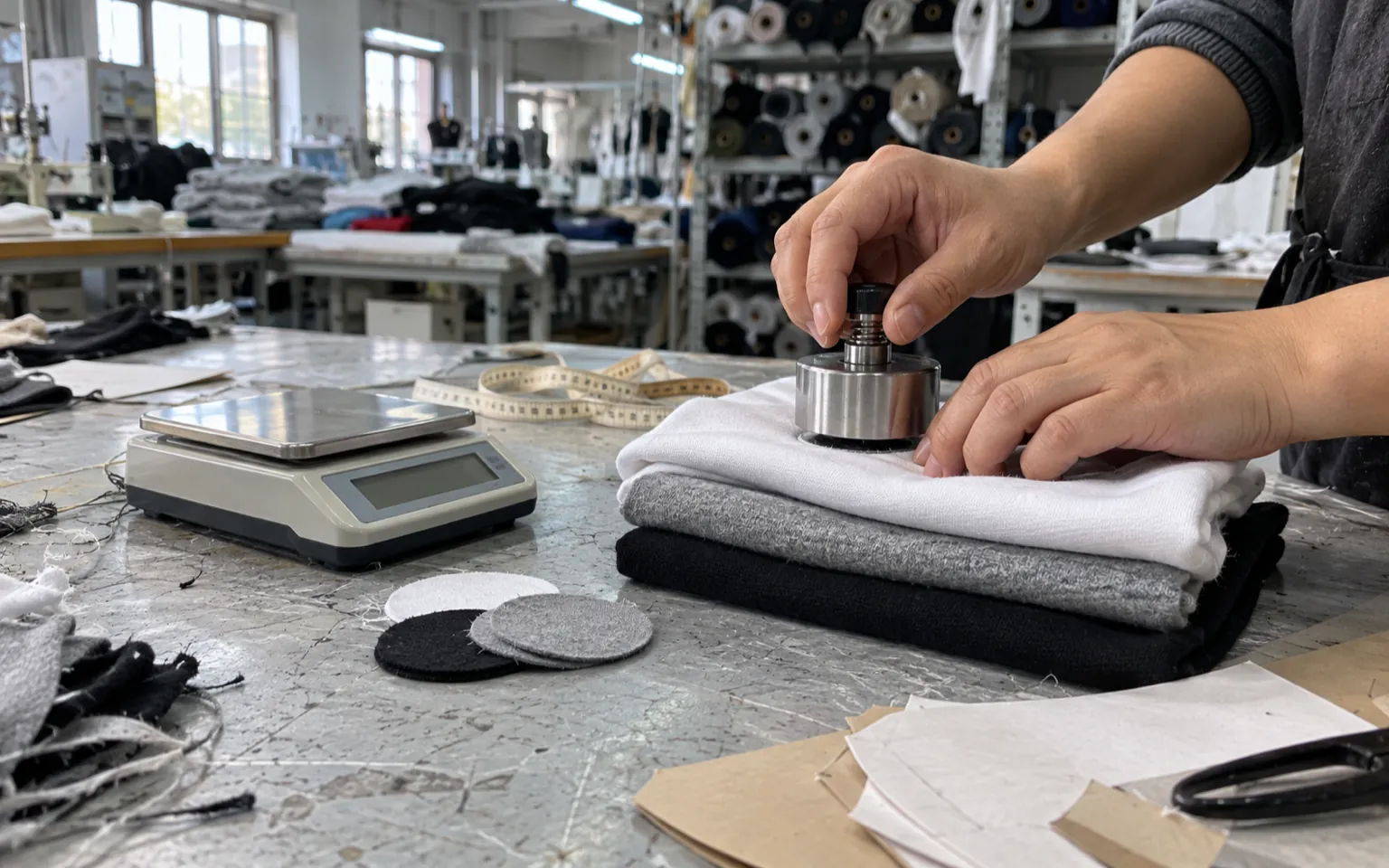
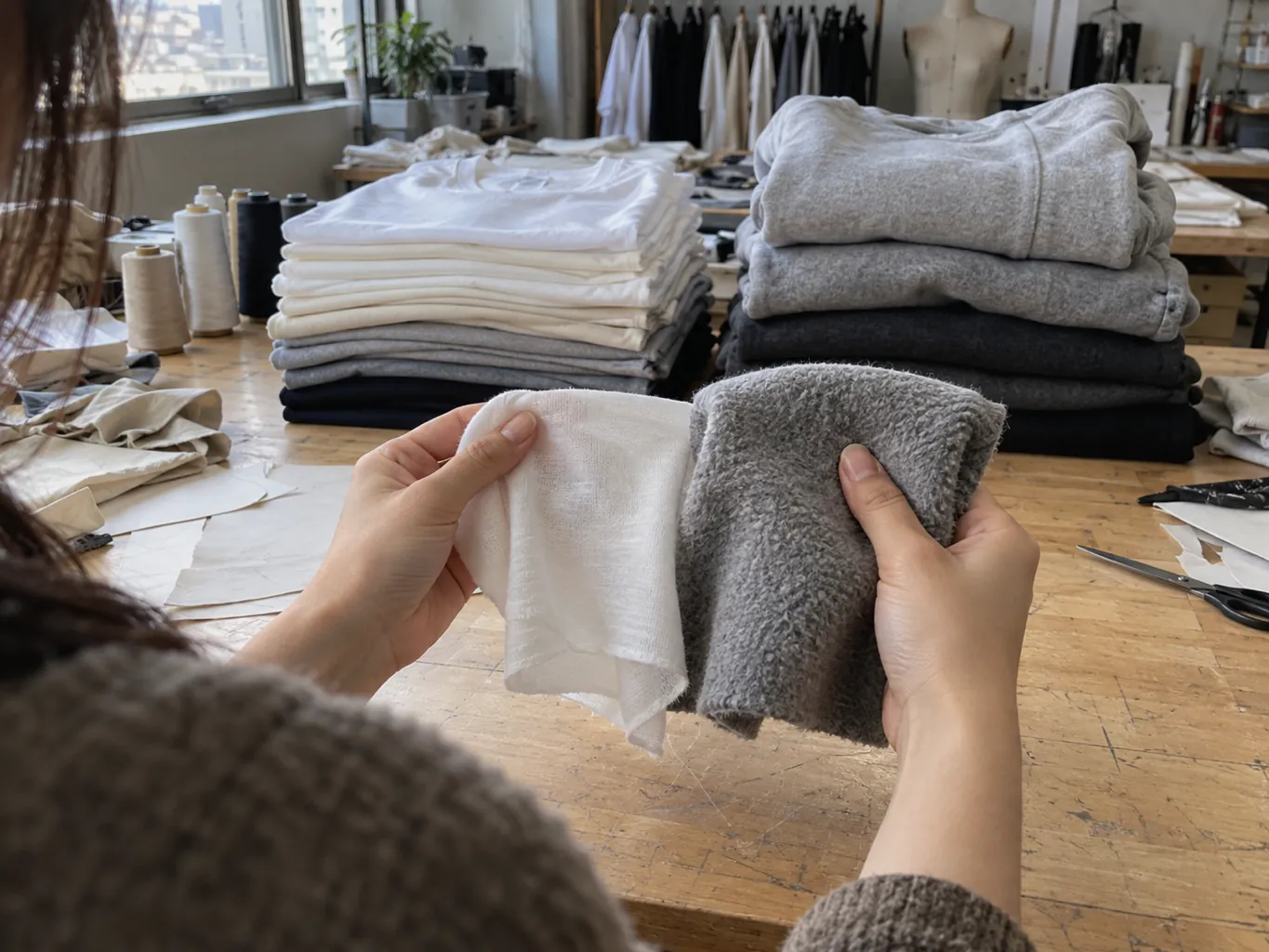
What Is GSM, and Why Should You Specify It First?
GSM means grams per square metre: fabric weight, not a quality rating.
A 180 GSM fabric weighs 180 grams per square metre. That number helps you compare materials before discussing a finished garment, whose total weight also includes its size, trims, pockets and decoration. A hoodie weighing 500 grams is therefore not automatically made from 500 GSM fabric. Ask whether the supplier’s number describes the cloth or the complete garment.
Within a comparable fibre and construction, increasing GSM generally means more material per unit of area. Moving from 180 to 220 GSM can change how a T-shirt hangs, how substantial it feels and how much fabric it consumes by weight. However, fabric weight does not directly measure thickness, warmth or opacity. A brushed surface, a compact knit and an open knit can behave differently even when their GSM matches.
Keep fibre and weight as separate specifications. A 180 GSM cotton jersey and a 180 GSM polyester jersey have the same mass per square metre. Their feel, printing behaviour and price can still differ. Yarn, knitting or weaving, and finishing still matter. Manufacturer Florix Sports’ GSM guide likewise distinguishes fabric weight from quality and recommends specifying composition and construction alongside GSM.
For your first enquiry, replace “thick cotton” with a measurable direction such as “100% cotton single jersey, 180 GSM, with a physical reference sample.” This is an example specification, not a recommendation for every T-shirt. It gives the factory something to match and gives you a basis for comparing quotations. The mistake to avoid is approving one number while leaving the rest of the fabric undefined.
What GSM Should You Choose for T-Shirts, Hoodies, Dresses and Other Garments?
Choose a category range first, then approve the actual fabric in your intended fit.
Use the table below to shortlist samples rather than approve production immediately. The T-shirt, sweatshirt, hoodie and performance-top ranges are published guidance from a clothing manufacturer, not Canton Fashion’s production specifications. The polo and woven-shirt entries use publicly listed fabric examples. Where a category needs more specific evidence, the required detail remains open.
| Garment | Fabric-weight starting point | What to check before approval |
|---|---|---|
| T-shirts and jersey tanks | T-shirts: 120–160 GSM lightweight; 170–220 GSM midweight; 230–350 GSM heavyweight | For tanks, confirm coverage, neckline stability and the intended fit rather than copying a tee specification |
| Polo shirts | Publicly listed piqué range: 180–250 GSM | Surface texture, collar compatibility and decoration |
| Sweatshirts | 220–280 GSM lightweight; 290–360 GSM midweight; 370–500 GSM heavyweight | Loopback versus brushed backing, drape and comfort |
| Hoodies | 240–300 GSM lightweight; 310–400 GSM midweight; 410–500+ GSM heavyweight | Hood weight, layering comfort and garment structure |
| Performance tops | 100–150 GSM lightweight; 150–200 GSM midweight | Stretch, recovery, coverage and intended activity |
| Yoga leggings | Across the industry, mid-weight stretch fabrics of approximately 180–250 GSM are typically suitable for standard leggings or yoga pants | Opacity under stretch, recovery and seam performance |
| Dresses | A woven cotton-poplin example is 125 GSM; other constructions need separate selection | Drape, lining requirements and coverage |
| Shirts | A publicly listed cotton poplin is 125 GSM | Transparency, collar structure and crease appearance |
The knitwear ranges come from Florix Sports. The piqué range is listed by Global Fabric Wholesale, while Rijs Textiles’ cotton poplin provides the 125 GSM woven example. These sources describe different products and should not be treated as one universal sizing chart.
Season changes which samples deserve attention. For an Australian summer T-shirt, begin by comparing lighter options within the published 120–160 GSM range against your required coverage. For a North American winter hoodie, compare the heavier hoodie ranges while checking whether the customer will wear it indoors, outdoors or under another layer. Country alone is not enough. The same winter collection can serve different uses in different regions.
Do not assign 220 GSM to a competitor garment because its product photograph looks substantial. Lighting, styling and fit can conceal the fabric’s actual behaviour. Request a fabric swatch, or send a reference garment and ask the factory to identify a matching direction. If you are choosing between 180 and 220 GSM, handle both and compare them in a garment sample before locking the order.
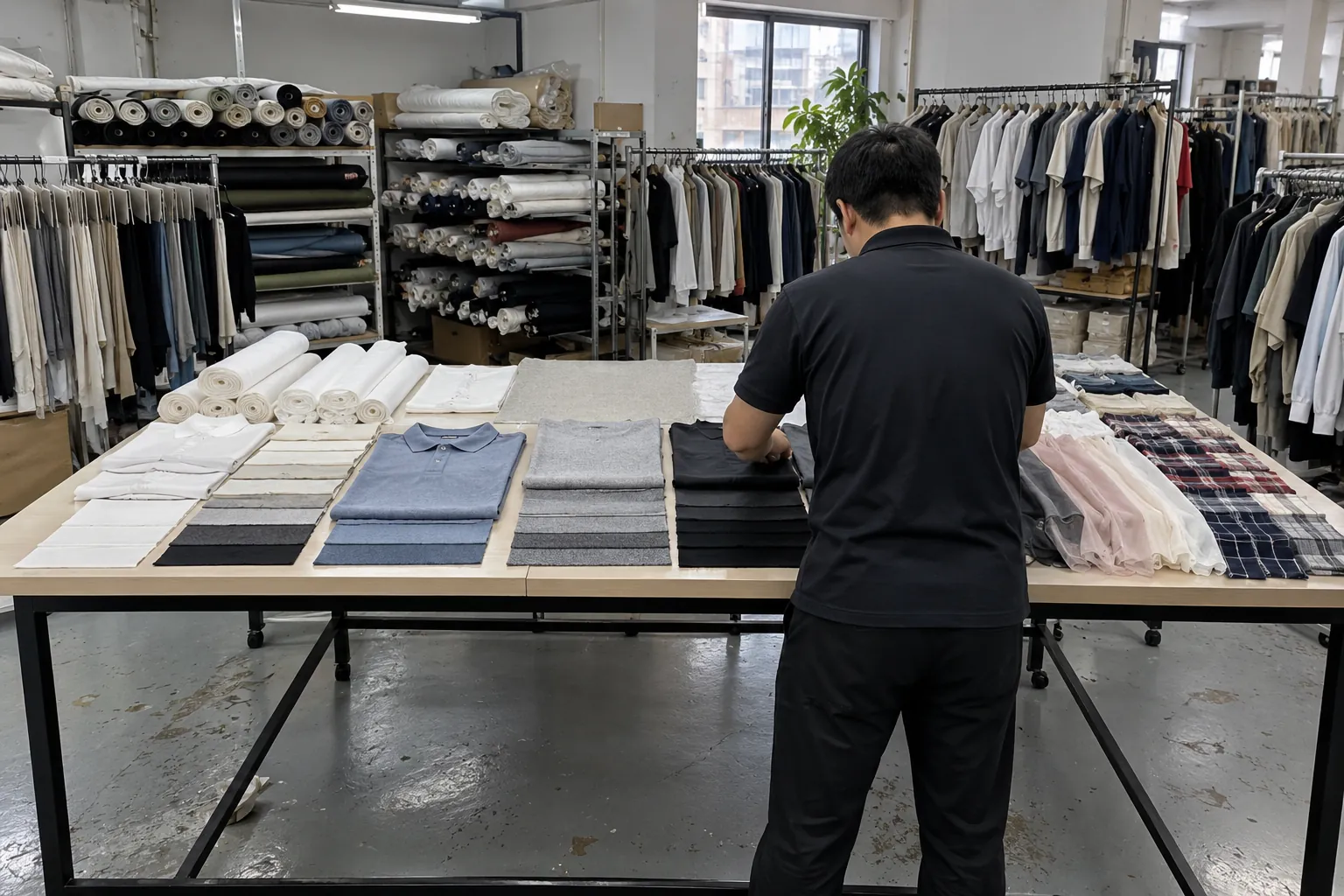
Cotton, Cotton-Polyester, Polyester or Viscose: Which Fibre Fits Your Brand and Retail Price?
Choose fibre for the customer experience and decoration, then check whether the complete garment fits your budget.
An entry-level collection does not automatically require polyester, and a higher retail price does not automatically require 100% cotton. Start with what the product must do: a printed everyday tee, a structured polo and a flowing dress need different material behaviour. For a 100–500-piece launch, available stock fabrics may give you more practical options than commissioning a new fabric. Compare those options against your intended selling price before paying for garment samples.
| Brand or product direction | Fibres to compare | Decision to make |
|---|---|---|
| Entry-level everyday basics | Stock cotton jersey and cotton-polyester blends | Which option meets the required feel and decoration at an acceptable finished cost? |
| Mid-market printed tees or polos | Combed cotton and clearly specified cotton-polyester blends | Does the surface, fit and wash result justify the price? |
| Products sold on drape or surface feel | Viscose fabrics and selected cotton constructions | Does the actual sample deliver the intended silhouette? |
| Printed performance apparel | Polyester and suitable stretch blends | Does the fabric support the activity and printing process? |
Composition must be written in full. Do not let “CVC” or “TC” stand in for an agreed blend percentage. Write “60% cotton / 40% polyester,” for example, if that is the blend you want. The abbreviation alone does not guarantee those percentages. Likewise, “100% cotton” tells the factory the fibre content but leaves yarn, construction and finishing unresolved.
For viscose or rayon, ask the supplier to identify the precise fibre description rather than accepting a loose commercial name. A specification containing “95% viscose / 5% elastane” is materially different from “100% viscose.” These are examples of how to write composition, not interchangeable recommendations. If stretch is necessary, the fabric’s recovery must also be checked in the intended garment.
Decoration belongs in the fabric decision. Cotton, blends and polyester can require different printing preparation, while embroidery must be sampled on the actual construction. Gildan’s published fabric and decoration guide notes that DTG pretreatment can differ between blends and 100% cotton, and that sublimation gives its best results on 100% polyester, preferably white or light colours. Approve the decoration on the selected fabric, then wash the sample before accepting its appearance and dimensions.
How Do Fabric and GSM Affect Cost, MOQ and Retail Price?
Higher GSM adds fabric weight; sourcing route, construction and consumption determine the actual cost increase.
For otherwise comparable materials, moving from 180 to 220 GSM adds approximately 22.2% to fabric mass for the same area. That is a calculation, not a prediction that the complete garment will cost 22.2% more. Sewing, decoration and packaging do not necessarily increase in the same proportion. In our production experience, a GSM change can create a difference of around US$1 per sweatshirt. The result depends on the garment and selected materials.
Separate price per kilogram from price per metre before comparing quotations. Fabric mass equals area multiplied by GSM, divided by 1,000 to convert grams to kilograms. For an illustrative 1-metre length of fabric at 1.5 metres wide, 180 GSM gives 0.27 kilograms and 220 GSM gives 0.33 kilograms. Actual garment consumption still depends on usable width, pattern layout, size breakdown and cutting loss.
Even the same fibre can have widely different purchasing prices. Stock acquired from surplus inventory, newly commissioned fabric and fabric made with specified mill-sourced yarn are different buying propositions. A lower price may therefore reflect a different sourcing route rather than an equivalent material offered more cheaply. Compare composition, GSM, width, finish, quantity and availability together.
Public supplier listings checked on October 1, 2026 illustrate that variation. These are advertised fabric prices. They are not Canton Fashion quotations, completed-transaction prices or estimates of Chinese factory procurement costs.
| Public fabric example | Advertised price and quantity basis | Source |
|---|---|---|
| Plain cotton poplin | €4.00/metre from 6 metres; €3.50/metre from 15 metres, excluding tax | Rijs Textiles |
| Viscose jersey, jeans colour | €5.00/metre from 6 metres down to €4.25/metre for a 50-metre roll, excluding tax | Rijs Textiles |
| Stretch viscose jersey | Listed wholesale price €7.40/metre plus VAT | ZEROW |
For comparable Chinese procurement examples, ask suppliers for current quotations. Cover combed cotton, polyester–cotton, polyester and rayon. Specify composition, GSM, width, price per kilogram or metre, minimum order quantity and quotation date. Do not combine the European listings above into a supposed Chinese market average.
For 100–500-piece orders, examine stock fabrics first because they remove the fabric-production stage. In our experience, custom knitting generally takes around one month for the fabric itself. Subsequent garment-production time is broadly similar. Ask for a separate quotation stating any additional lead time for custom dyeing and the fabric minimums for custom knitting and dyeing. Keep per-colour and per-batch requirements separate. Work backwards from your target retail price. Allow for garment production, freight, import costs, fulfilment and your own selling costs before deciding what you can spend on fabric.
What Fabric Specifications Should You Put in a Factory RFQ?
Specify composition, GSM, construction, colour and measurement conditions together, then attach sizes and quantities.
A useful RFQ lets the factory calculate consumption and identify a material rather than interpret adjectives. “Cotton, 180 GSM” is a starting point, but two suppliers can answer it with different fabrics. Add the construction, finish and decoration requirements before comparing their prices. For a 100-piece order, unclear specifications can still affect every piece.
Include the following fields in your enquiry. Where you do not know the answer, ask for options instead of entering a number you cannot assess. Yarn count, in particular, needs its measurement system: “32s” should not stand alone without clarification. A reference sample can guide selection while the written specification is completed.
| RFQ field | What to write |
|---|---|
| Garment and intended use | Category, fit, season and destination market |
| Composition | Full fibre names and percentages |
| Fabric weight | Target GSM and whether it refers to the finished fabric before laundering or after an agreed wash |
| Yarn | Requested count and count system, such as Ne 32/1 where appropriate, or a request for recommendations |
| Construction | Single jersey, rib, piqué, woven plain weave, loopback or brushed fleece |
| Finish | Any requested brushing, washing or other treatment |
| Colour | Pantone reference with its system identified, or a physical colour sample |
| Weight tolerance | Agreed permitted variation and measurement conditions |
| Fabric width | Usable width for consumption and quotation |
| Decoration | Artwork, process, dimensions and placement |
| Size breakdown | Measurement chart and quantities by size and colour |
| Approval reference | Identifiable swatch, garment sample and artwork version |
Do not approve “180 GSM” without agreeing when it is measured. Laundering can change fabric dimensions and therefore mass per unit area. Establish whether the requirement applies before or after washing, and define the measurement conditions and tolerance in writing. Ask Canton Fashion to confirm the GSM tolerance and measurement conditions for your order. Keep the pre-wash state separate from any agreed post-wash state.
For an initial discussion, you could request a 100% cotton single-jersey tee at 180 GSM, attach your size chart and state a total of 100 pieces. That is an example enquiry, not a production-ready specification until the remaining requirements are agreed. Canton Fashion’s usual MOQ is 100 pieces, with specific needs open to discussion. Our actual sampling period is generally 7–14 days, so send the fabric direction and artwork together.
How Should You Verify Fabric Before Bulk Production?
Approve the fabric and garment sample, check washing results, and agree inspection requirements before bulk production.
Begin with an identifiable fabric swatch and the supplier’s specification. Check GSM, surface feel, colour and construction, then move to a garment sample using the intended material and decoration. A swatch cannot show how a neckline, hood or print behaves on the complete garment. Canton Fashion’s sampling generally takes 7–14 days, and sample fees are usually US$50–150 per piece, depending on the style.
Wash the sample using the care method you expect customers to follow. Record its measurements before washing, then measure it again after drying under consistent conditions. If an illustrative 70-centimetre measurement becomes 68 centimetres, the dimensional reduction is approximately 2.9%. This is a calculation example, not an acceptable-shrinkage promise. Agree the permitted result for your product rather than treating one wash at home as formal laboratory certification.
Check more than dimensions. Compare colour appearance, any staining or transfer, print condition and garment shape after washing. Stretch garments also need assessment in their intended fit. If your product requires formal colourfastness or dimensional-stability evidence, specify the test method and acceptance criteria before ordering. Across the industry, ISO 105-C06 is a test method for colourfastness to laundering. The applicable methods and acceptance limits for your product must be agreed separately.
After sample confirmation, our bulk-production period is approximately 30–45 days. With one 7–14-day sampling round, the calculated planning window is 37–59 days. That excludes revisions, sample shipping or delivery to your market. Custom knitting can require around another month for fabric production, so agree how that stage fits into the schedule. Do not promise a launch date based only on the bulk sewing period.
For small orders, we generally recommend final inspection rather than a separate pre-production inspection visit. Inspection typically costs US$100–200 per person-day in our experience. Agree AQL 2.5/4.0 alongside defect definitions, defect categories and the sampling plan. Those values do not guarantee that every shipment will pass. For new customers, our terms are a 30% deposit. Inspection is available before shipment. We ship after the balance is paid.
Can the Right Fabric Still Go Wrong? Three Real Confirmation Mistakes
Yes: our three cases show how unresolved approvals can undermine an otherwise producible order.
In the first case, production was pushed forward before the sample had been confirmed. The logo used for the goods differed from the customer’s final design and the logo displayed on the brand’s website. The issue was the artwork version, rather than a fabric-quality defect, but the difference could affect consumers’ impression of the brand. The lesson for a 100–500-piece run is to identify and approve the final artwork before production proceeds.
Apply that same version control to the fabric. A 180 GSM swatch shown early in development should not silently become a different material when production begins. Record which swatch and specification were approved, and connect them to the garment sample. If colour, GSM or finish changes, resolve that change before treating the earlier approval as valid.
In the second case, a buyer had not agreed inspection requirements in advance. At final inspection, the buyer applied expectations much stricter than those intended for the ordinary consumer-grade product. The shipment could not go out. Based on our assessment, the goods would have passed the AQL 2.5/4.0 consumer-product inspection basis described by the author. The practical correction is to agree what counts as a defect and how acceptance will be assessed before production.
In the third case, customer Ann Lin had not confirmed packaging when the order was placed. As shipment approached, she requested a custom zipper bag, whose production needed approximately 3–4 weeks. There was insufficient time, so the goods shipped in ordinary transparent bags without a logo. Packaging and hangtag artwork should therefore be confirmed with the order, rather than introduced when finished garments are ready.
These cases concern artwork, inspection and packaging, but the fabric decision follows the same approval logic. “180 GSM cotton” remains incomplete if colour, composition, measurement conditions or acceptable variation are unresolved. Confirm each requirement before the production stage that depends on it. Selecting the material is only useful when the specification used for bulk goods matches what you approved.
Next Step: Send Your Fabric Requirements for a Reply Within One Working Day
Send your garment, fabric direction and quantity; Canton Fashion responds within one working day.
Use the enquiry form or the WhatsApp button on this page to start. Include the garment category, intended season and market, quantity, and target retail price. If you already have a fabric direction, send its composition and GSM; if you do not, send a reference image or physical-sample details. A first order of 100–500 pieces gives us a clear starting point for discussing material availability and production.
Canton Fashion was established in Guangzhou in 2015 and coordinates a network of cooperating factories. Our usual MOQ is 100 pieces, with specific requirements open to discussion. Sampling generally takes 7–14 days, followed by approximately 30–45 days for bulk production after sample confirmation. If custom knitting is required, the additional fabric-production stage needs to be included in the plan.
BSCI credentials are held in the names of cooperating factories, not Canton Fashion itself. Ask for the documentation relevant to the factory proposed for your order. That distinction matters when you are checking who will produce the goods and which documents cover that operation. It should be resolved alongside your material and sample approvals, rather than assumed from a company introduction.
Send your category, target GSM or reference, fibre preference, size breakdown and piece count to request a quotation and fabric recommendations. Include artwork and packaging requirements if they are already available. For a 100-piece first run, a clear brief helps us assess the actual material and consumption behind the price. Start with the specifications you know, and we can discuss the remaining choices before sampling.
Frequently Asked Questions
Is “100% cotton, 180 GSM” enough to get comparable factory quotations?
No; “100% cotton, 180 GSM” still leaves construction, finish, colour and measurement conditions undefined. Add usable width, decoration requirements, sizes and quantities, and agree the permitted GSM variation before comparing quotations.
Will moving from 180 to 220 GSM raise the garment price by 22.2%?
No; moving from 180 to 220 GSM increases fabric mass by approximately 22.2% for the same area, but does not predict the same increase in the complete garment price. The actual cost increase depends on sourcing, construction and fabric consumption, while sewing, decoration and packaging do not necessarily rise in the same proportion.
For a first order of 100–500 pieces, should I consider stock fabric or custom knitting?
Examine stock fabrics first for a 100–500-piece order because they remove the fabric-production stage. In Canton Fashion’s experience, custom knitting generally takes around one month for the fabric itself, while subsequent garment-production time is broadly similar.
Does the 37–59-day planning window include delivery to my market?
No; the 37–59-day window covers one 7–14-day sampling round and approximately 30–45 days of bulk production after sample confirmation. It excludes revisions, sample shipping and delivery to your market; custom knitting can require around another month for fabric production.
Whose BSCI documentation should I request for my order?
Request the BSCI documentation relevant to the cooperating factory proposed for your order. BSCI credentials are held in the names of cooperating factories, not Canton Fashion itself.