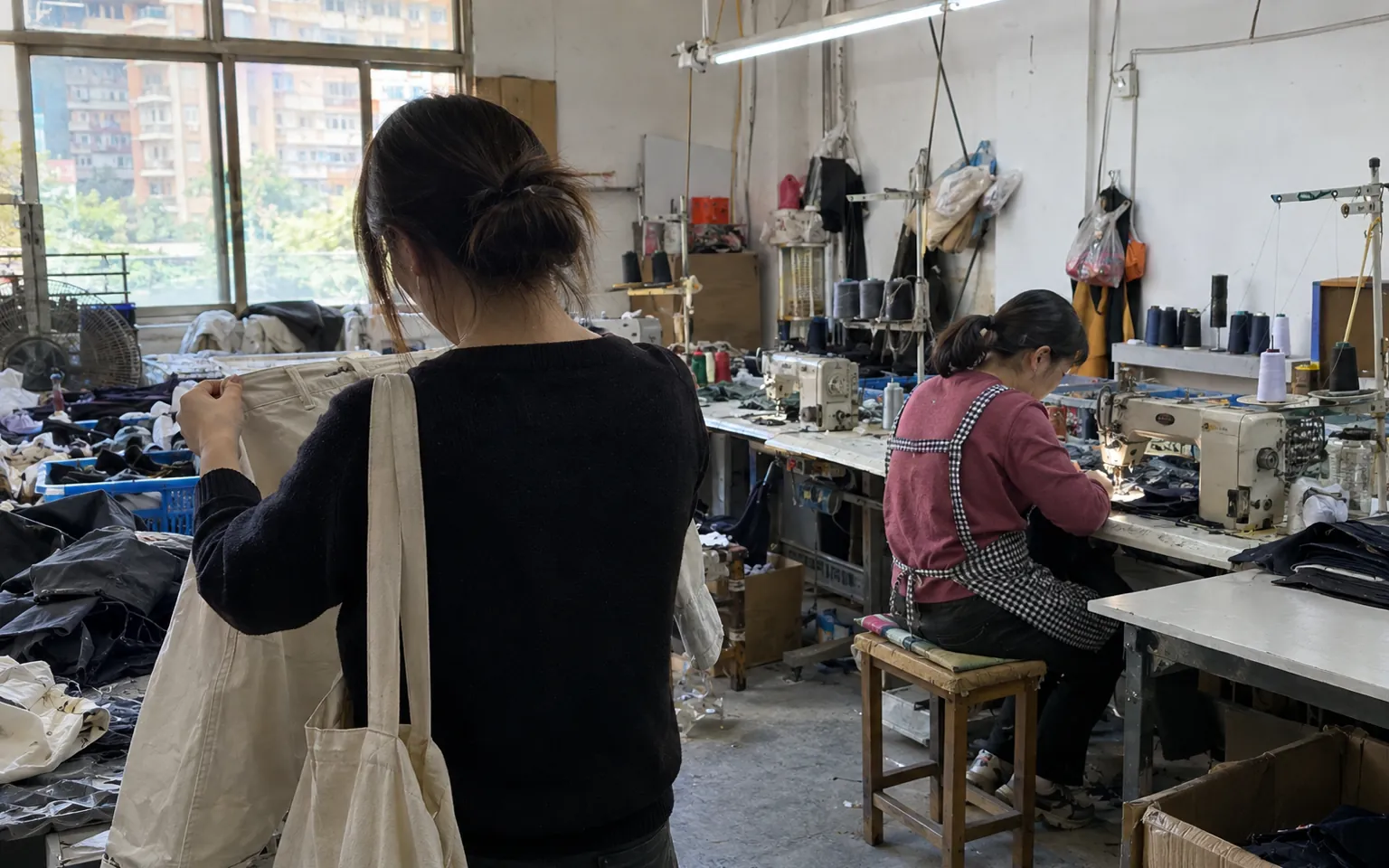
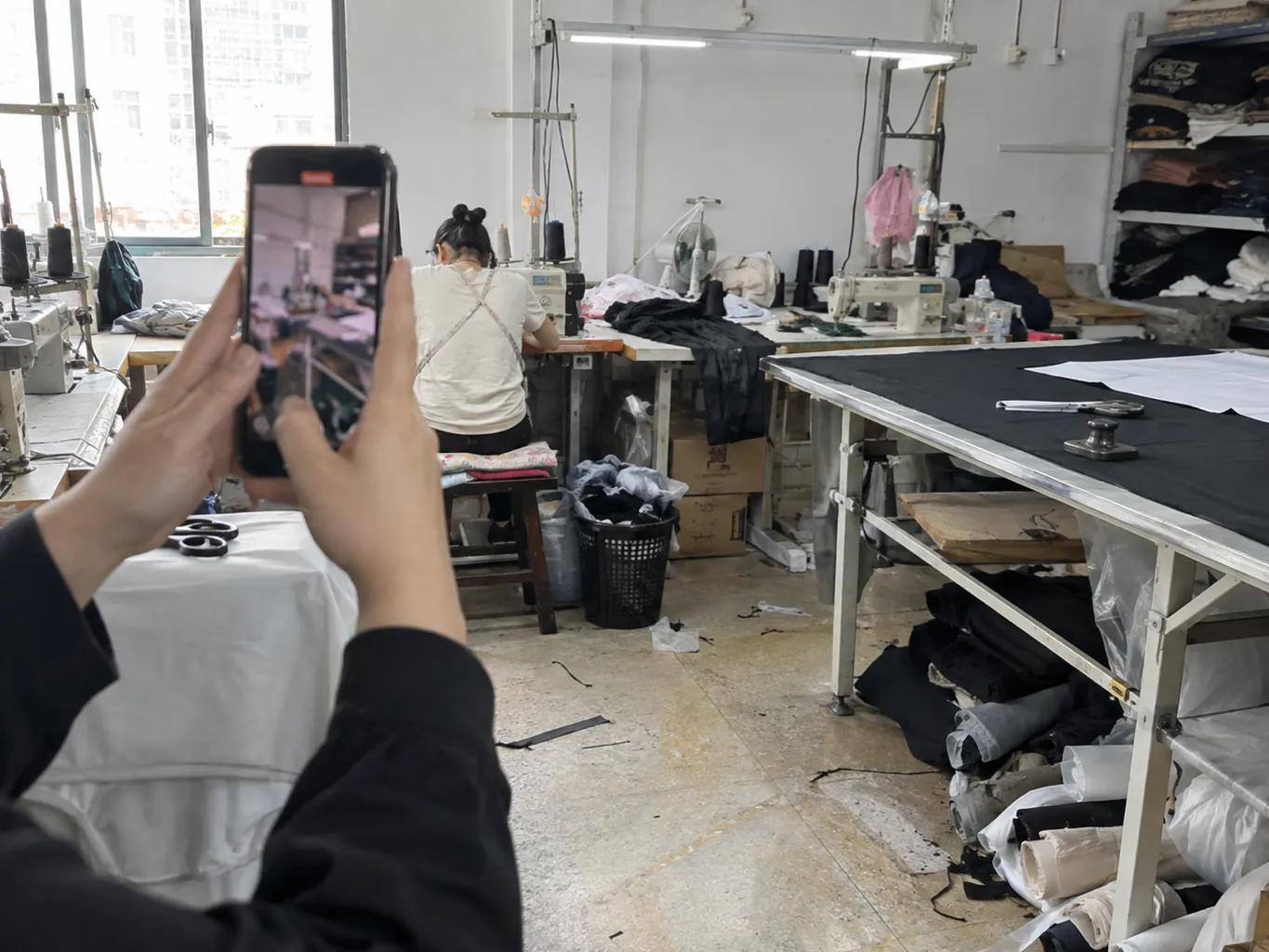
Finding a reliable clothing manufacturer in Guangzhou looks simple. It is not. Factories, trading companies and middlemen all use the same two words: "direct manufacturer." Wire a deposit to the wrong one and you may never see the money or the order.
Start with the documents. Then ask who will make your goods and what payment terms protect your deposit. We have sat on the factory side of this table for ten years, and the buyers who come out fine are the ones who treat a first order as a verification exercise, not a shopping trip.
Why vetting a Guangzhou garment factory is harder than elsewhere
Guangzhou's garment supply chain mixes factories, trading companies and brokers in the same buildings, and many of the "manufacturers" on B2B platforms are trading companies rather than factories. That is not a problem by itself. The problem is not knowing who actually makes your goods.
Guangzhou sits at the centre of the Pearl River Delta garment cluster. Thousands of factories, everything from fast fashion to technical outerwear. That density gives you production capacity you will not find elsewhere. It also creates a verification problem. The supplier answering your inquiry might be a factory with 200 workers, a trading company with a showroom and no sewing machines, or one person working from a serviced office.
Trading companies are not the enemy. For a small brand, a good trading company is often the better partner. It replies in your language and in your time zone, keeps one account manager on your order from sampling to shipment, coordinates the work you would otherwise chase across five workshops — fabric, trims, printing, embroidery, washing, labels, packing, export paperwork — and takes the trial orders that factories turn down. What a factory gives you in production control, a trading company often gives you in communication and service.
The risk is not that a supplier is a trading company. The risk is not knowing who actually makes your goods. An honest trading company will say so, name the factory that will run your order and put that floor on a live video call. Then you have what you need: the factory is real, and the company you are paying is answerable for producing your order there. Size is not the test. A 30-machine workshop that actually makes your garments beats a large factory that never touches them.
We are on that side of the table ourselves. Canton Fashion was set up in Guangzhou in 2015, and we coordinate a network of partner factories instead of running one big floor under our own roof. That is exactly why we tell buyers to ask who makes the goods. We can name the factory that will run your order, and we can put it on a live call. A supplier who cannot do the same is the one to worry about.
Where it goes wrong is the trading company that claims to be the factory and keeps the production site vague. Your order then moves to whichever workshop is free, the delivery date becomes a guess, and when quality slips there is nobody standing behind it. Small orders feel this most. Mature factories prioritise large repeat clients and turn down a 200-piece trial, so small brands usually end up with a trading company or a smaller workshop. That is fine, as long as you know which floor your garments will be made on.
Geography explains the confusion. In Haizhu and Baiyun, one office building can hold 20 trading companies. Every one of them lists "garment manufacturing" on its licence. Every one uses stock photos downloaded from the same handful of real factories.
Five things to get before you send any money
Ask for these before any payment: the business licence, dated factory photos, samples from past orders, recent sample courier receipts, and third-party audit reports if they have them. These are ordinary requests. A supplier who will not answer them is the problem — not a supplier who happens not to hold one particular certificate.
Most of this paperwork should reach you in 24 to 48 hours. If a document is missing, ask how they handle that side of the business before you draw conclusions. Evasiveness is the warning sign, not the absence of a certificate.
1. Business licence (营业执照)
Ask for a photo of the business licence showing the registered scope of business (经营范围). It should list garment manufacturing or textile production, not only garment trading. Cross-check the company name on China's National Enterprise Credit Information Publicity System (gsxt.gov.cn). The registered address should match the factory location they claim.
Export credentials are optional. Plenty of legitimate factories and trading companies do not export in their own name — they use an export agent, who handles customs declaration and the shipping paperwork for a fee. That is a normal way of working in Guangzhou, and it says nothing bad about the supplier. So do not screen anyone on whether they hold an export licence. If they do not, ask how your order will be exported and who the agent is.
Look for signs of photo editing: mismatched fonts, blurry stamps, uneven lighting. Genuine documents carry embossed stamps. Ask them to tilt the photo so you can see the raised texture.
2. Factory floor photos and video
Stock photos travel far on Chinese B2B platforms. Ask for photos with a handwritten sign showing today's date and your company name, held up in front of the production equipment. Five to ten photos are enough. Sewing lines, cutting tables, fabric storage, the inspection area, the packing zone.
Better still, ask for a short walkthrough video. Two or three minutes, showing workers at machines, fabric rolls in storage, finished garments being packed. Faking photos is easy. Staging a convincing video with live production is much harder.
3. Samples from past customer orders
Ask for photos of three to five orders completed in the last six months: finished garments, packaging, and commercial invoices with customer names blacked out. This proves production capability and shows the complexity they usually handle.
Watch the range of styles. If they claim to make everything from basic tees to structured blazers but every photo is a simple knit item, their technical capacity may not match your product.
4. Sample courier receipts
If they have already sent you physical samples, keep the tracking number and check that it traces back to the address they call their factory. Compare the sender location with the licence address.
If they have not sent samples yet but say they can, ask to see courier receipts for samples sent to other clients in the past month, recipient details blurred. That confirms they ship samples routinely rather than just talking about it.
5. Third-party audit reports
BSCI, WRAP, Sedex or SMETA reports from the last 12 months show the factory goes through external compliance reviews. This is the point where buyers most often get the fit wrong. Audits cost real money. They are usually done by factories above a certain size — and those are exactly the factories that will not take a 100-300 piece trial order. Match the supplier to your own level. As a small buyer, do not make third-party audits a condition of the order. A factory without them is not a worse factory at your volume.
If they do have a recent report, read the cover page before the rest of it. Whose name is on it? Certificates belong to the site that was audited, not to the company that sells you the goods. Ask which site the audit covered and whether that is the site that will run your order. If the two do not match, that is not fraud — it is information you need before you pay.
If they do not have a report, the practical substitute is a site visit you pay for yourself (see the cost ranges below). What matters at your order size is simpler: the factory looks real, and the supplier commits to producing your goods there.
Be sceptical of certificates with no report number or issuing-body contact details. Call the certification body named on the certificate and confirm it is genuine.
Five questions you must ask, and the answers that are red flags
Ask these five questions and pay attention to how they answer. Vague replies, an instant "yes" to everything, or refusal to discuss problems all point to a middleman rather than a factory.
The questions matter less than the pattern of the answers. A real factory owner knows their own constraints and speaks in specifics. A supplier that has to broker your order out gives flexible, sales-shaped answers built to close the deal. We have watched both styles in the same meeting. The specific one is the honest one.
Question 1: Which steps do you do in-house?
Ask: "Which production steps do you handle in-house, and which do you outsource?"
A real factory will spell it out. For example: "We cut, sew and inspect here. Embroidery goes to a specialist workshop ten minutes away, and we buy buttons from a local supplier."
If the answer is "we are a trading company", that is not a red flag. It is useful information. Follow up with the question that actually matters: which factory will make my order, and can I see it on a live video call? A trading company that names the site and puts it on camera is a workable partner. What you are trying to avoid is not trading companies. It is not knowing where your garments are made.
Danger signs:
- "We do everything in-house" (unlikely for a small factory; most outsource at least one specialist process)
- "We can do anything you need" (they broker orders out to different factories depending on the job)
- Vague talk of "partnerships" without saying what stays inside their own walls
Question 2: How long will sampling take for my style, and what does it cost?
Ask: "How long will sampling take for this specific style, and what is the sample fee?"
A factory that actually makes samples will ask you questions first: fabric, trims, special finishes, sizing. Then it gives a timeline based on its current workload, usually 7–14 days. days for a standard style. If someone quotes you three days, ask what they are skipping.
Danger signs:
- Offering "free samples" before seeing your tech pack (someone pays for that sample; if it is not you, ask where the money comes from)
- Quoting a sampling timeline without asking about fabric or construction
- Giving the same timeline for every style regardless of complexity
Question 3: What is your MOQ, and can you run a 50-piece trial?
Ask: "What is your minimum order quantity? Can you do a 50-piece trial run?"
At Canton Fashion, our standard MOQ is 100 pieces, though we can be flexible depending on the customer's requirements.
Real factories have real minimums, set by fabric minimums and line efficiency. A factory might say: "Our standard MOQ is 300 pieces per style, but we can do 100 pieces for a trial at a higher unit price."
Danger signs:
- "We can do any quantity" (your order will be placed with whichever factory fits the volume)
- Accepting very small runs (under 50 pieces) without mentioning a higher unit cost (probably outsourced to a smaller workshop)
- The MOQ changes every time you ask a follow-up question
Question 4: How much deposit, and when is the balance due?
Ask: "How much deposit do you require, and when is the balance due?"
For new customers, we require a 30% deposit. You can inspect the goods before shipment, and the balance must be paid before we ship. For returning customers, we may offer 30–60-day payment terms on the balance, depending on the results of a Sinosure credit check.
The industry norm is a 30-50% deposit with the balance before shipping, or after a pre-shipment inspection once you know each other. On a first order, the deposit goes to the company's official business account, in the same name as the business licence.
Danger signs:
- Asking for 100% up front
- A deposit above 50% on a first order
- Insisting on Western Union, MoneyGram or crypto for a first payment (nothing traceable, no buyer protection)
- Asking a first-time buyer to send the deposit to a personal account rather than the company account (fine with a factory you already know well — see the note in the payment section)
- No way to accept PayPal or a credit card (established exporters usually offer several options)
Question 5: What happens if something goes wrong?
Ask: "If there is a quality problem or a delivery delay, what is your compensation policy?"
A factory with real quality systems will describe its defect tolerance, its remake policy and its refund terms, and will agree to write them into the contract.
Danger signs:
- "Don't worry, we never have problems" (every factory has problems sometimes; this answer means they will not take responsibility when one arrives)
- Refusing to put compensation terms in writing
- Deflecting with "we'll discuss it if it happens"
How to tell a real factory from a fake one on a video tour (remote audit checklist)
Insist on a live video tour of at least 20 minutes covering the production lines, fabric storage and offices. Recorded videos can be borrowed from another factory. A live tour tells you within minutes whether the site is real and who will actually make your goods.
Remote factory audits have been normal since 2020. Video only works, though, if you know what to look at and you insist on real-time interaction rather than a pre-recorded clip. You are not scoring the factory on size. A 30-machine workshop can be a perfectly good partner. You are checking that the place is real and that it is set up to make your product.
Insist on live video, not a recording
Say clearly that you want a live call on WhatsApp, WeChat or Zoom during factory hours (usually 9 am to 5 pm China time, Monday to Friday). Whoever gives the tour should answer your questions as they go and point the camera where you ask.
Ask for something they cannot have prepared: "Walk over to the cutting table and show me what fabric is being cut right now." A real factory guide does it immediately. Someone playing a recording cannot.
Minimum length: 20 minutes. Anything shorter does not give you time to see the different areas or ask follow-up questions.
If the company you are paying coordinates several partner factories, settle one thing before the tour starts: which factory is running your order. Then ask the guide to confirm it on camera, standing on that floor. Whoever holds the phone should be able to say the factory name and where it is without checking with anyone first.
The production line: are machines running, how many workers, how much work in progress
Watch the sewing lines for two or three minutes without cutting away. You should see:
- Machines running (not every machine, but at least 40-50% during working hours)
- Workers at their stations (a factory with 20 sewing machines should have at least 10-15 people visible)
- Work-in-progress garments stacked beside each station or moving down the line
Ask to see the cutting area. An active factory has fabric laid out on cutting tables, cutting machines or shears nearby, and pattern pieces sorted by order.
Ask about capacity if it is useful to you, but do not turn it into a size test. Output depends far more on the product mix than on how big the floor is. 30,000–50,000 T-shirts or hoodies a month may have a monthly capacity of only 10,000–20,000 pieces for more complex styles, such as dresses and suits. Capacity varies considerably by product. Treat the answer as a sanity check on the delivery date you are being promised, not as a reason to walk away from a smaller workshop.
Look for half-finished goods between stations. In a working factory you see stacks of cut fabric waiting for sewing, sewn panels waiting for assembly, and assembled garments waiting for finishing. An empty floor means nothing is in production right now.
The warehouse: fabric and trim stock
Ask to see fabric storage. Real factories hold fabric inventory, rolls on racks organised by material or by order. Ask: "Which order is that fabric for?" A factory manager can answer at once.
Check the trim and notions storage: thread, zippers, buttons, labels, hang tags. A factory that produces regularly has visible stock of these. Trading companies usually do not stock raw materials themselves, which is normal. Just make sure the workshop that will produce your order does.
The office: is there a design, pattern-making and QC team on site
Ask to see the offices and support areas. Look for:
- A pattern-making area with tables, pattern paper and measuring tools
- A sample room where development happens
- A quality-control station with measuring tools, a light box for fabric inspection and a defect tracking board
- Admin desks with shipping documents and order spreadsheets
A factory does not need a big office staff. It does need the infrastructure to develop patterns, track orders and manage quality. A trading company's office looks like a sales showroom: samples on display, sales staff at desks, no technical equipment. That is not a problem in itself — plenty of good trading companies work this way. It simply means the tour should continue at the factory floor that will make your order, with the trading company introducing you there on camera.
Ask a worker on the floor: what style, which customer
If the manager agrees (some will not, for client confidentiality), ask to speak briefly with a worker or a line supervisor. Simple questions such as "What style are you working on today?" or "How long have you worked here?" confirm that the people on camera actually work at this site.
The point is not to interrogate anyone. It is to confirm the place runs the way they say. A supervisor should be able to say which customer order they are producing without giving away confidential details.
How to pay a deposit safely: method and percentage
On a first order, pay at most a 30-50% deposit, to the company account or through PayPal. Anything above 50%, or a Western Union transfer, is a high-risk red flag. A personal account is a different question: avoid it with a supplier you do not know, and treat it as normal once you do.
Deposit scams follow a pattern. The seller pushes for full payment up front, offers a discount for Western Union or crypto, then vanishes once the money lands. Stick to the payment structures the industry already uses and you take that risk off the table.
The safe range: a 30-50% deposit
The standard split is 30% when you approve the pre-production sample and 70% before shipment. Some factories ask 50% up front and 50% before shipping. Both are reasonable.
Above 50%, the risk sits almost entirely with you. If the factory hits production trouble, goes under or simply disappears, you have lost most of the order value and have nothing left to bargain with.
Be especially wary of a request for 100% prepayment. Legitimate factories understand that buyers need to inspect goods before the final payment. A supplier demanding everything up front is either short of cash or running a scam.
For large orders, negotiate milestones: 30% deposit, 30% at the halfway point (confirmed with inspection photos), 40% before shipping. That spreads the risk on both sides.
Payment methods compared
Ranked by how much protection you get as the buyer:
Strongest protection:
- Credit card or PayPal Business: both offer dispute resolution. If the seller does not deliver, you can file a claim.
- Bank transfer to the company account (公对公转账): the recipient's business name must match the licence. It creates a legal paper trail and shows the company operates formally.
Medium protection:
- Alibaba Trade Assurance or a similar platform escrow: the platform holds the funds until you confirm receipt or inspection, and mediates if there is a dispute.
Minimal protection:
- Western Union, MoneyGram and similar cash transfer services: built for personal remittances, not trade. Once sent, the money is gone. In B2B garment sourcing these are red flags, full stop.
- Cryptocurrency: irreversible. No legitimate factory demands it.
Paying into a personal account (私人账户) depends on the relationship, not the rule
With a supplier you have never worked with, do not send a first payment to a personal account. There is no legal link to the business, and if something goes wrong, recovery is close to impossible. That is the case that deserves the red flag.
Once you know the factory and the people behind it — you have met them, ordered before, you know where they work and who they are — paying into a personal account is normal and perfectly safe in practice. Some buyers even prefer it, because it is faster and skips bank formalities on both sides. The test is not the account type. It is whether you actually know who is on the other end.
Contract terms: write the deposit conditions down
Before any deposit, get a written contract, or at minimum a proforma invoice, that states:
- Deposit amount and due date
- Balance amount and what triggers it ("before shipping" or "after pre-shipment inspection")
- Refund conditions (if the factory cancels, runs more than X days late, or misses the quality standard)
- Production timeline and delivery date
- Quality standard and inspection process
Spell out the deposit refund: "If the factory cannot deliver goods meeting the approved sample standard within [X] days, the buyer may cancel the order and receive a full deposit refund within [Y] days."
A supplier that will not put terms in writing is a supplier to walk away from. A contract protects both sides, and any professional factory will sign one without fuss.
Three mistakes that cost brands their orders: what ten years of manufacturing taught us
Mistake 1: bulk production started before the sample was confirmed
The buyer confirmed the order and pushed the factory straight into bulk without signing off the final sample.
The garments came out carrying the wrong version of the logo. It was not a quality problem in the sewing, but the logo did not match the one on the buyer's own website, and that difference shows up in how customers read the brand.
The right way: no bulk until the sample is confirmed in writing, with the final artwork attached. Send the logo as a named, dated file, and have the factory confirm in writing that this is the version its production artwork will be made from.
Mistake 2: the inspection standard was never discussed
The buyer never said what standard the goods would be inspected against. We make ordinary consumer products, not luxury goods. At inspection the buyer went over everything with a magnifying glass and flagged things most people would not call defects.
The batch could not be shipped — even though it would have passed a normal civilian inspection standard, AQL 2.5 for major defects and AQL 4.0 for minor ones.
The right way: agree the inspection standard before production starts and write it into the order. Name the AQL levels, name who inspects, and say what happens if the batch fails. This one is almost always a conversation that never happened.
Mistake 3: packaging confirmed after production
Ann Lin confirmed her order without confirming the packaging. Only when the goods were about to ship did she ask for a custom zipper bag — and she did not know that a custom zipper bag takes three to four weeks to produce.
There was no time left. The order went out in plain transparent bags with no logo, and the packaging she had planned never reached her customers.
The right way: confirm every packaging and trim item — bags, hang tags, labels, stickers — at the same moment you confirm the order, and approve all the artwork together. Anything added later carries its own lead time and can hold up the whole shipment.
Still not sure? Three more ways to lower the risk
If doubts remain after the document checks and the video tour, hire a third-party inspection service (from roughly $100-200 per person-day) or start with a trial order of 100-200 units before committing to a larger run.
Even after careful vetting, a first-time buyer working with an overseas factory is dealing with real uncertainty. These checks cost money. They can expose a problem before you place a larger order.
Third-party factory inspection
Inspection companies such as SGS, Bureau Veritas (BV), Intertek (ITS) and QIMA run on-site audits, from a basic check that the factory exists and operates as described, up to full compliance audits covering labour practices, safety and capacity. For a small trial order, the basic visit is the level that makes sense. A full compliance audit is for buyers placing volumes that justify it.
A basic factory verification costs: $100–$200 per person per day for a basic factory visit. A formal audit may cost $3,000–$5,000.
The inspector visits the site, photographs the production areas, interviews management and delivers a report within three to five business days. That confirms the factory is real, owns the equipment it claims, and keeps basic operating standards.
Worth paying for when:
- Your first order is above $10,000
- The supplier's documents cannot be fully verified on your own
- You cannot visit China in person
- The factory has no English-language presence or references online
Probably not needed when:
- The trial order is under $2,000 (the inspection fee becomes a large share of the order)
- The supplier has extensive third-party reviews on Alibaba or elsewhere
- The factory is willing to run a very small test order first
Start with a small trial order
The most reliable way to vet a supplier is to give it a small order and judge the result. On time and acceptable quality: scale up. Anything else: you have limited your exposure.
Our advice is 100-200 units, or whatever minimum the factory will accept, before you commit to 1,000 or more. At Canton Fashion, our MOQ is 100 pieces, so we accept trial orders of 100–200 pieces.
During the trial, judge four things:
- Responsiveness: do they answer within 24 hours, and update you on progress without being asked?
- Sample accuracy: does bulk match the approved sample in fabric, construction and measurements?
- Timeline: do they ship on the promised date, or do delays appear without explanation?
- Consistency: inspect the trial batch carefully; basic construction defects should stay under 2-3%.
If the trial goes well, you have seen how the supplier handles a real order before placing a larger one. If it fails, you learned it for a few hundred dollars instead of tens of thousands.
Use Alibaba Trade Assurance or PayPal to protect the payment
If the factory sells on Alibaba, order through Trade Assurance. The platform holds your payment in escrow and releases it only after you confirm receipt or inspection. If goods do not arrive or do not match the order, Alibaba mediates and can refund you.
Trade Assurance covers:
- Product quality (goods do not match the listing or the sample)
- Shipping delays (delivery runs past the agreed date)
- Non-delivery (goods never arrive)
Where a supplier takes PayPal, pay through PayPal Business (goods and services), never Friends & Family. Business payments carry buyer protection and dispute resolution. Friends & Family transfers carry nothing.
Hire a local sourcing agent or QC team
For large orders (above $20,000) or a long-term supplier relationship, consider a local QC agent or sourcing consultant based in Guangzhou. They visit factories in person, verify operations and inspect at different stages of production.
Local QC services typically charge:
- Factory audit visit: $100–$200 per person per day for a basic visit, or $3,000–$5,000 for a formal audit.
- Pre-production inspection: $100–$200 per person per day.
- In-line inspection during production: $100–$200 per person per day.
- Pre-shipment final inspection: $100–$200 per person per day. For small orders, we recommend a final pre-shipment inspection; a pre-production inspection is generally unnecessary.
A local agent can also negotiate terms, clarify technical specifications and mediate disputes. They can check the factory for you and report what they find.
Ready to vet Canton Fashion? Ask us the same questions
Everything above applies to us too. We provide our business licence, live factory tours, past-order samples and transparent payment terms because we would rather work with buyers who do their homework.
Ask for the documents. Ask the hard questions. Verify us before you send a deposit.
Some plain facts about us, so you can check them. Canton Fashion was set up in Guangzhou in 2015 and works with a network of partner factories rather than one owned production hall. The BSCI certificate we can show you sits in the name of the partner factory that was audited, not in ours. Ask us whose name is on it, and check that name against the factory that will run your order. We would rather you heard that from us than found it out later from a certificate you cannot trace.
What we can provide:
- Business licence and registration details for you to verify, plus a straight answer on how your order will be exported
- A live video factory tour (20+ minutes) at a time that suits you during business hours
- Photos of recently completed orders, customer details redacted
- Our usual MOQ is 100 units, with flexibility for specific requirements; new customers pay a 30% deposit and settle the balance before shipment; sampling generally takes 7–14 days. Our sample fee generally ranges from $50 to $150 per piece, depending on the style. T-shirts and sweatshirts cost less, while suits and shirts cost more.
We mostly work with small and mid-size brands on their first or second production run in China. Our clients typically order 100–500 units for smaller orders. E-commerce clients whose marketing performs well may place repeat orders for several thousand units or even 10,000 or more. These brands want guidance through sampling and production, at the smaller volumes that larger factories turn away.
To enquire, use the contact details on our website. Our team will assist you with your enquiry, and we generally respond within one business day.
The inquiry process is simple: send us a message and someone will pick it up and reply within one business day.
Whether you end up with Canton Fashion or someone else, the checks above will tell you who is a real factory and who is not. Two or three hours of due diligence before a deposit can save months of trouble and thousands of dollars.
Contact us here and we will send the documentation so you can begin vetting us.
Frequently Asked Questions
Can a trading company be a good partner for a small order?
Yes. A good trading company can coordinate production and take trial orders that larger factories turn down. Ask it to name the factory making your goods and show that floor on a live video call.
Does the supplier need its own export licence?
No. Legitimate factories and trading companies may use an export agent for customs declaration and shipping paperwork. Ask how your order will be exported and who the agent is.
What if the factory has no third-party audit report?
A small buyer does not need to make an audit report a condition of the order. If you need another way to check the site, pay for a factory visit and confirm that the supplier will produce your goods there.
What should I approve before bulk production starts?
Approve the final sample in writing, with the final artwork attached. Agree on the inspection standard, and confirm packaging and trim items when you confirm the order.
When should I place a larger order after a trial?
Scale up if the trial ships on time and its quality is acceptable. Check whether the supplier responds promptly, the goods match the approved sample, and the batch is consistent.