Canton Fashion was founded in 2015 in Guangzhou, and we coordinate a network of partner factories for OEM/ODM garment production. Choosing the decoration method is step one of every project we take on. The rest of this page covers each method group: what it costs, what MOQ it needs, how long it takes, and how to keep bulk production looking like the sample. Where a number matters, we give our real number — MOQ, sample fees, lead times — because a budget you can actually build is worth more than adjectives.
What decoration methods can you put on a hoodie or T-shirt?
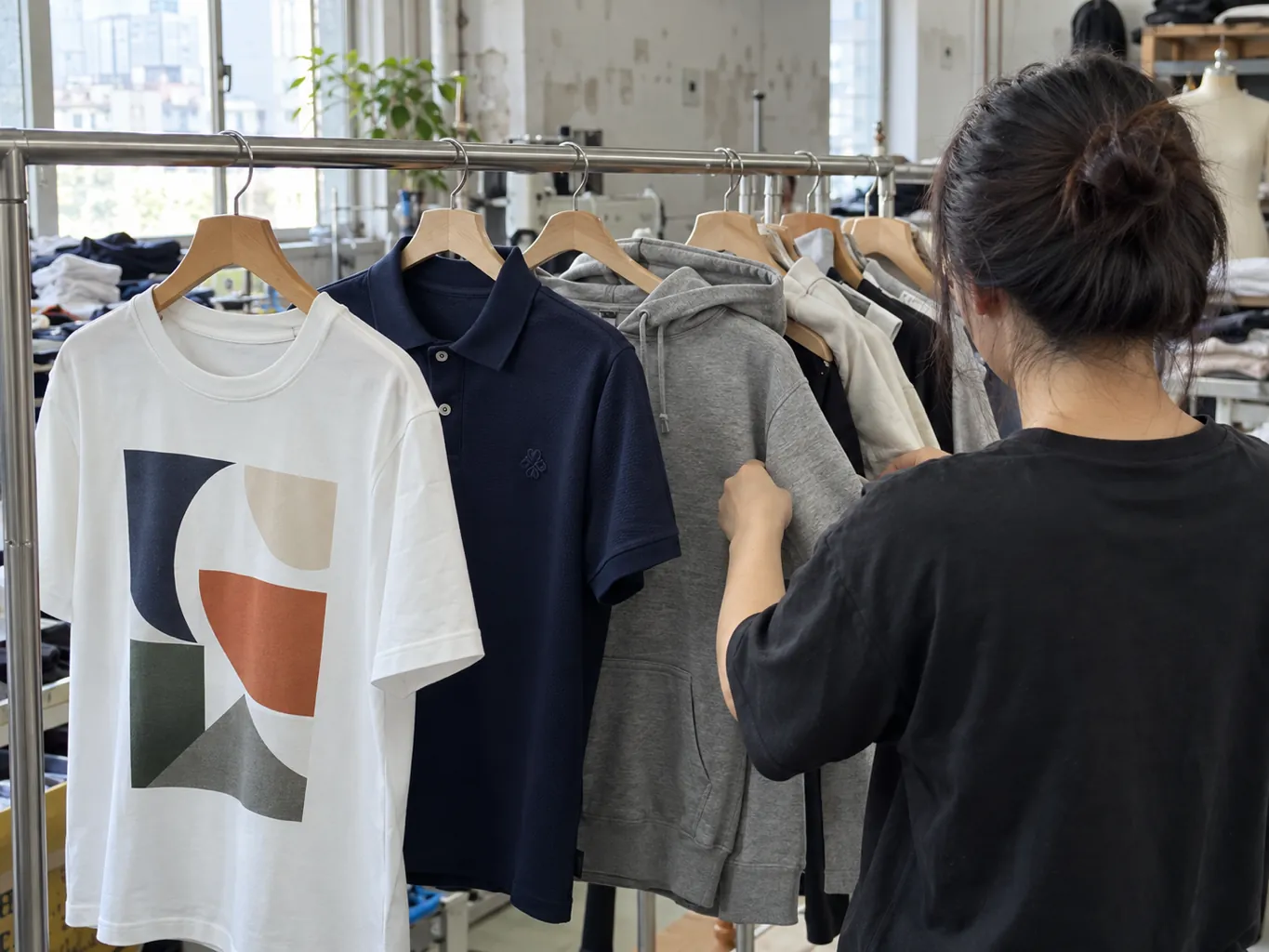
Four method groups cover almost everything: screen printing, digital printing (DTG or DTF), embroidery, and garment finishing.
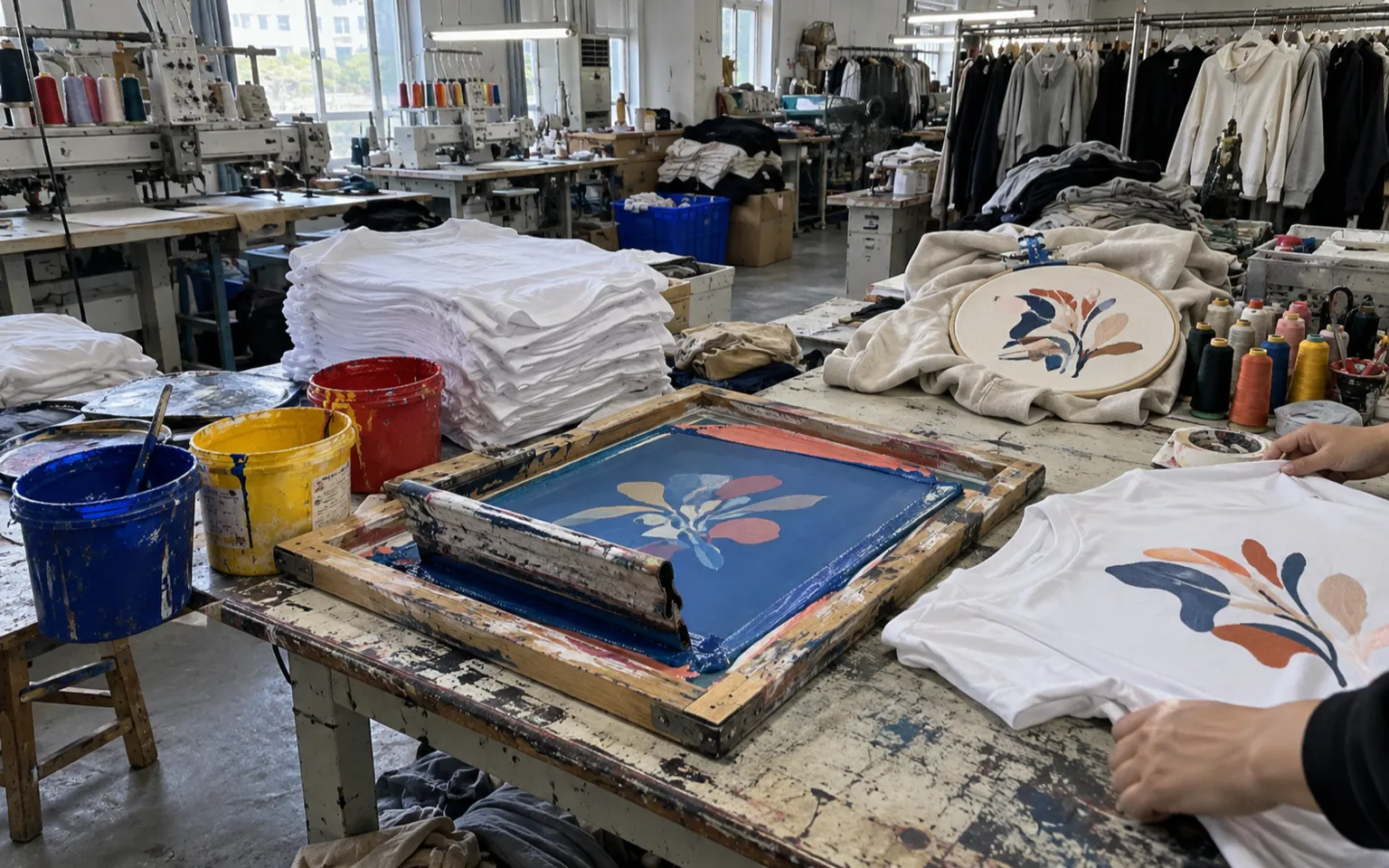
Screen printing pushes ink through a mesh screen — one screen per color in the artwork. It suits bold graphics with a limited color count. The unit price drops as the order grows, because the setup cost spreads across more pieces. If your first order runs 500 pieces or more and your artwork has four or fewer solid colors, screen printing is almost always the cheapest route.
Digital printing splits into two technologies. DTG (direct-to-garment) jets ink straight into the fabric, which gives the softest hand feel and works best on high-cotton garments. DTF prints the artwork onto a film and heat-presses it onto the garment, which adheres to a wider range of fabrics including polyester blends and performance knits. Neither needs screens, so full-color and photo-real artwork is practical even at 50 pieces.
Embroidery stitches thread directly into the garment. The raised, dimensional look reads premium at small sizes — a chest logo, a cap front, a cuff mark. It works at low quantities because there's no screen setup, but converting artwork into stitch instructions carries a one-time digitizing fee.
Finishing isn't a graphic at all. Enzyme washes, distressing, and soft-hand treatments change how the garment looks and feels off the shelf — this is what makes a blank "look expensive." Finishing touches every piece in the order, so it affects the unit price regardless of your artwork.
To choose between them, answer three questions in this order:
- How many colors does the final artwork have?
- How many pieces is the first order?
- Is the selling point the graphic, or the fabric itself?
Artwork and budget first, method second. A first-season brand with a two-color logo and a 200-piece order needs a different answer than one with a full-color illustration and a 50-piece test run. Both answers exist inside these four groups.
Screen printing or digital printing?
Screen printing wins on cost per piece at volume; digital printing wins on full-color artwork and first orders in the low hundreds.
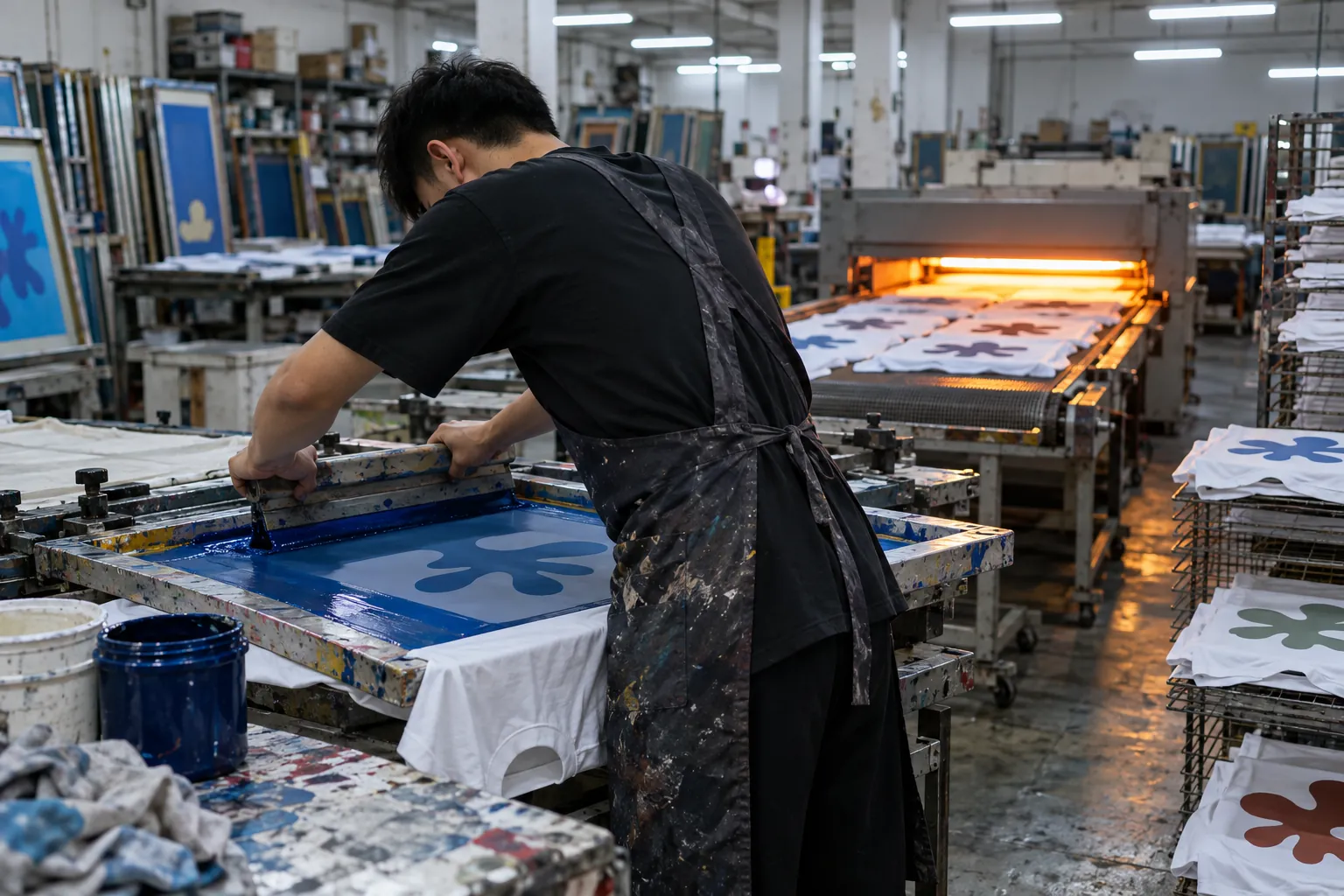
Screen printing burns one screen per color, pushes ink through with a squeegee, and cures it with heat. The setup cost sits upfront, so the economics only work when quantity absorbs it — that's why a 1,000-piece run prices so differently from a 100-piece run of the same design. Artwork with one to four solid colors is the sweet spot. Each color adds a screen, and each screen adds to the setup bill — a four-color job carries roughly four times the screen setup of a one-color job, and that fee is fixed regardless of order size, which is why it lands hardest on a 100-piece run. Ask for the screen fee per color in writing with the quote. Properly cured, a screen print survives normal wash cycles without cracking — the curing step is where cheap factories cut corners, so it's worth asking how prints are cured, not just how much they cost.
Digital printing removes screens entirely. DTG prints after pretreatment on dark garments. Photographic gradients and unlimited colors come at a flat per-piece cost. Switching between pieces is easy, so names and numbers are practical. DTF gangs multiple artworks onto one film sheet, which makes small mixed designs economical, and it bonds to polyester and blends where DTG struggles. What you trade is hand feel: DTG is nearly invisible on cotton, while DTF carries a slightly thicker film layer. Per-piece pricing and minimums: in the industry's standard pricing, neither DTG nor DTF uses screens or setup fees, and neither carries a minimum order quantity — DTF is typically competitive with or cheaper than DTG and gets more cost-efficient as volume grows, because transfers can be printed in bulk ahead of time, while DTG stays competitive on smaller runs.
One variable changes the math more than buyers expect: the base fabric color. Light ink on a dark garment needs a white underbase or a second pass — one extra screen, one extra print pass, visibly brighter colors. Same artwork on black and on white can quote differently, so the base color belongs in your inquiry, not in a surprise later. Across the industry, dark garments cost more for the same artwork: a white underbase adds one screen and one print pass, which effectively increases the color count by one — so a two-color design on black prices like a three-color print.
Ink choice changes how the garment wears. Water-based ink soaks into cotton fibers — soft, breathable, ages with the fabric. Choose it for T-shirts worn against skin. Plastisol sits on the surface as a thicker, more opaque layer with very strong wash durability — standard for hoodies and outerwear, where breathability matters less. Neither is "better"; they're different tools, and a factory should ask which feel you want before quoting.
A working rule of thumb from the orders we coordinate:
- 1–4 color graphic, 300+ pieces → screen printing
- Full color, photo, or gradient artwork under 300 pieces → DTG or DTF
- Artwork that changes per piece (names, numbers) → DTG or DTF; per-name screen changes aren't practical
Embroidery, specialty decoration, and garment finishing
Embroidery and specialty prints build the brand mark; finishing builds the premium feel — put the money where your selling point is.
Embroidery prices by stitch count and setup, not colors. A small chest logo carries far fewer stitches than a full back piece, which is why chest marks stay affordable for first orders. A one-time digitizing fee converts your artwork into a stitch file, some shops add a separate embroidery setup fee, and the stitching itself is quoted by stitch count rather than by color. Ask for each of those lines separately. On fleece and hoodies, the fabric needs proper stabilizing backing, or the stitching puckers the panel. A real factory handles that by default; a cheap one skips it. Thread outlasts any ink in the wash, which is why workwear and cap brands default to it.
Specialty decoration is where a first drop builds memory. Puff print expands under heat curing into a raised, 3D surface. Flock lays down a short-fiber velvet texture. Foil and metallic transfers give a mirror shine. Each is a different machine and a different skill set — not every factory runs all of them, so send a reference photo and ask per technique rather than assuming. These methods carry their own minimums, setup fees and per-piece costs, which vary by supplier and order volume — so ask for the minimum, the setup fee and the unit price technique by technique. One practical step before committing: run a wash test on the actual bulk fabric, because specialty effects age differently on different cottons and blends.
Finishing covers what happens to the whole garment after sewing. An enzyme wash strips surface fuzz and stiffness from the fabric. Distressed and vintage washes give a worn-in look. Silicone and softener treatments change the hand feel at the consumer's first touch. What the treatment does is consistent across the industry: cellulase enzymes break down cellulose at the fabric surface, which softens the hand feel and leaves a mild faded, worn-in look. Per-piece cost is quoted per wash recipe rather than as one standard industry rate, so ask for the wash as its own line on the quote. The trade-off is dimensional stability — washing moves dimensions, so the factory needs a controlled shrinkage spec, and you need to know it: the usual retail specification is up to 3% for woven garments and up to 5% for cotton knits, measured in both directions after three wash-and-dry cycles, and many brands tighten tailored items and shirting to about 2%. If you skip finishing to save money, budget for the fabric to feel like a blank; if you overspend on finishing under a loud graphic, the graphic still does the selling.
The decision rule we give first-season brands: if the selling point is the artwork, spend on print or embroidery first and keep the fabric stock. If the selling point is the garment itself — premium basics, heavyweight blanks — spend on fabric and finishing first and keep the mark small. Very few first seasons need to spend heavily on both.
What are the MOQs and unit prices for each method? Our numbers, in the open
Our MOQ is 100 pieces per style, sampling takes 7–14 days at $50–150 per piece, and bulk production runs about 30–45 days after sample approval.
Most manufacturer blogs describe decoration methods in detail and go quiet the moment numbers come up. We'll just publish ours, because a first-season buyer needs a budget line, not a mystery.
MOQ: 100 pieces per style.
That's our standard across decoration methods. If your first order genuinely can't reach 100 pieces, tell us — we can be flexible when the situation makes sense, but we'd rather say that openly than quote 50 and quietly compromise somewhere else.
Sampling: 7–14 days, $50–150 per piece.
T-shirts and hoodies sit at the lower end; shirts and blazers cost more because the construction is heavier. The sample fee covers the one-off work of your specific style — it's not a margin line.
Bulk unit prices by method and quantity ladder (T-shirt and hoodie examples, 100 / 500 / 1,000 pieces): Bulk unit prices are quoted per style rather than published as a fixed ladder, because the per-piece number moves with the fabric, the number of print positions, and the decoration method. Send the artwork, the quantity, and the size breakdown, and we'll quote your style line by line, with the decoration cost shown on its own line. Once the quote is in front of you, you can build a real per-style budget before you ever send an inquiry — that's the point of pricing it line by line.
Beyond the unit price, three cost lines belong in the same quote: screen fees per color, the embroidery digitizing fee, and packaging trims such as hang tags, zipper bags, and stickers. Setup fees vary by printer and by design, and packaging trims are quoted per item from your artwork. Ask for all of them in one email, because a quote that only covers the garment will grow later.
Payment terms, also out in the open.
New customers pay a 30% deposit; you can inspect the goods before shipment, and the balance is paid before the goods ship. For customers we've worked with long enough, we can offer 30–60 day balance terms based on the Sinosure credit check result.
Realistic order pattern: first orders usually run 100–500 pieces. E-commerce brands whose marketing lands reorder in the thousands, sometimes tens of thousands. Price your first order as a test, not as the final number.
What should you include in a first inquiry to get an accurate quote?
Send vector artwork with Pantone codes and print sizes, your quantity and size breakdown, fabric weight and color, and packaging artwork — and you'll get a usable quote in one round instead of three.
Design files first. Factories need vector artwork (AI, EPS, SVG, or PDF) because it scales to any print size without pixelation, plus Pantone codes so the ink mix matches your brand color across sample and bulk, plus the dimensions of each print position. One real case from our orders: a buyer pushed straight into bulk production without confirming the final logo version. The factory worked from an older file, and the finished garments carried a logo that differed from the one on the brand's website. It wasn't a workmanship defect — the wrong file was a communication failure — but consumers notice the mismatch, and reprinting a logo position on finished stock costs real money. The fix costs nothing: confirm the final artwork version in writing when you approve the sample.
Quantities, sizes, fabric. "300 pieces, S:M:L:XL = 1:2:2:1, 300 GSM cotton fleece, black" is the level of detail that makes a quote real. The size ratio affects marker planning; the fabric weight affects which decoration holds up; and the fabric color decides whether the printer needs an underbase — the same graphic on black quotes differently from white, as covered above.
Not sure about the method, color count, or positions? Send the picture anyway. A real factory will come back with the options and the cost difference between them — naming the method, the setup cost, and the unit price at your quantity. That specificity is part of the job, and it's also how you tell a factory's reply apart from a trading company's one-line number.
Packaging and trims belong at order confirmation, not at shipping. Hang tags, zipper bags, stickers — all artwork confirmed when the order is confirmed. Another real case: a buyer named Ann Lin confirmed her order without confirming packaging. Right before the shipment date, she asked for custom zipper bags, and zipper bags take about 3–4 weeks to produce. There was no time, so the order shipped in plain clear bags without a logo. Every trim artwork gets locked at order confirmation, full stop.
Finally, our response commitment: send the inquiry and a real person picks it up — you get a reply within one business day, including the questions above if anything is missing, so nothing stalls silently.
How long do sampling and bulk production take? Plan backward from your launch date
Sampling takes 7–14 days, bulk production about 30–45 days after sample approval — start at least three months before your target launch date, and count freight on top.
The sample stage runs 7–14 days at $50–150 per piece, depending on style. Approve it in writing, and write down which version you approved — that approved sample becomes the reference for everything that follows.
Bulk production runs about 30–45 days from sample approval. For context on scale: across our partner network, T-shirts and hoodies run 30,000–50,000 pieces per month, while dresses and blazers run 10,000–20,000. A 100–500 piece first order is never limited by capacity — scheduling, trims, and confirmation speed are what move the date.
Work backward from your target on-shelf date:
- Lock the final artwork and all trim artwork
- Sampling: 7–14 days
- Approve the sample in writing
- Bulk production: 30–45 days
- Final inspection: typically one person-day on site
- Sea or air freight to your warehouse
Add those up and the production side alone runs about 2.5 months; with freight and buffer, three months is the safe minimum for a fixed launch date. If bulk lands too close to your selling season, air freight rescues weeks at a visibly higher cost — decide that trade-off before production starts, not during it.
On reorders: a repeat of an approved style moves faster because the sample question is already settled. That's why the first-order pattern matters — most of our e-commerce clients start at 100–500 pieces, and the ones whose marketing works come back for thousands. Plan the reorder before the stockout, not after.
How do you keep bulk production matching the sample? Inspection, without overpaying
Agree the inspection standard in writing before production, run one final inspection for small orders at $100–200 per person-day, and match audit spending to what you actually need.
Set the inspection standard before the deposit, not after the goods are finished. We produce consumer-grade goods, not luxury, and the common consumer-goods benchmark is AQL 2.5 for major defects and AQL 4.0 for minor defects. One real case: a buyer never discussed the standard, then inspected the finished order against a bar stricter than consumer use — things most people wouldn't count as defects all got flagged. The shipment stalled and the goods couldn't move as planned. Under AQL 2.5/4.0, that order would have passed. None of this gets fixed by arguing after the fact; it gets fixed by writing the standard and the reference sample into the order confirmation.
For small orders, one final inspection is enough. Inspection runs $100–200 per person per day, and for a 300-piece first order a final check catches what matters. Pre-production and during-production inspections buy little at that scale and add days — spend the money on the end of the line.
Know the difference between a visit and an audit. A simple look around the factory — real machines, real workers, real organization — costs $100–200 per person per day and answers the question "is this factory real and functional." A formal social-compliance audit runs $3,000–5,000. If your market or a retail partner requires the certificate, do the audit. If you just need to know who you're wiring a deposit to, the visit answers it at a fraction of the cost.
On certifications, we'll be precise: our partner factories hold BSCI certification in their own names — it is not a Canton Fashion-owned certificate, and we don't present it as one. Whoever you end up working with, ask whose name the certificate sits under and ask to see it.
And keep your approved sample. The buyer holds one, the factory holds one, and bulk gets checked against it under the standard you already agreed. Lock the artwork, approve it in writing, agree the standard, inspect at the end — that chain is the whole system. It's not complicated; it just has to happen in that order.
What's next? Send your artwork and get a method recommendation within one business day
Send your artwork, your expected quantity, and your target launch date — you'll get a decoration recommendation, a price range, and a timeline within one business day.
Those three inputs carry most of the weight. Final (or near-final) artwork tells us which methods fit the design; expected quantity tells us which method prices best at your scale; the launch date tells us whether the 7–14 day sampling plus 30–45 day production window works, or needs adjusting.
What comes back: the recommended decoration method with the reasoning, a price range at your quantity (including the setup and trim costs, not just the garment), and a timeline from sampling to shipment.
Reach us through the contact page on this site — the WhatsApp button on this page is the fastest route — and a real person will reply within one business day. Bring the artwork, even if it's rough. That's the easiest part to fix.
Frequently Asked Questions
Do I have to pay for a sample, and how much does it cost?
Yes — sampling takes 7–14 days at $50–150 per piece, and the fee covers the one-off work of your specific style, not a margin line. T-shirts and hoodies sit at the lower end; shirts and blazers cost more because the construction is heavier.
How many pieces do I need for a first order?
Our MOQ is 100 pieces per style, and that standard applies across decoration methods. If your first order genuinely can't reach 100 pieces, tell us — we can be flexible when the situation makes sense.
Does printing cost more on a dark garment than on a light one?
Yes — light ink on a dark garment needs a white underbase or a second pass, which adds one extra screen and one extra print pass. That's why the same artwork can quote differently on black than on white, so put the base fabric color in your inquiry.
Which digital printing method should I use for polyester or performance fabric?
DTF is the better fit for polyester blends and performance knits, because it bonds to a wider range of fabrics. DTG works best on high-cotton garments and gives the softest hand feel, but it struggles where DTF holds.
What are the payment terms for a first order?
New customers pay a 30% deposit, can inspect the goods before shipment, and pay the balance before the goods ship. After we've worked together long enough, we can offer 30–60 day balance terms based on the Sinosure credit check result.