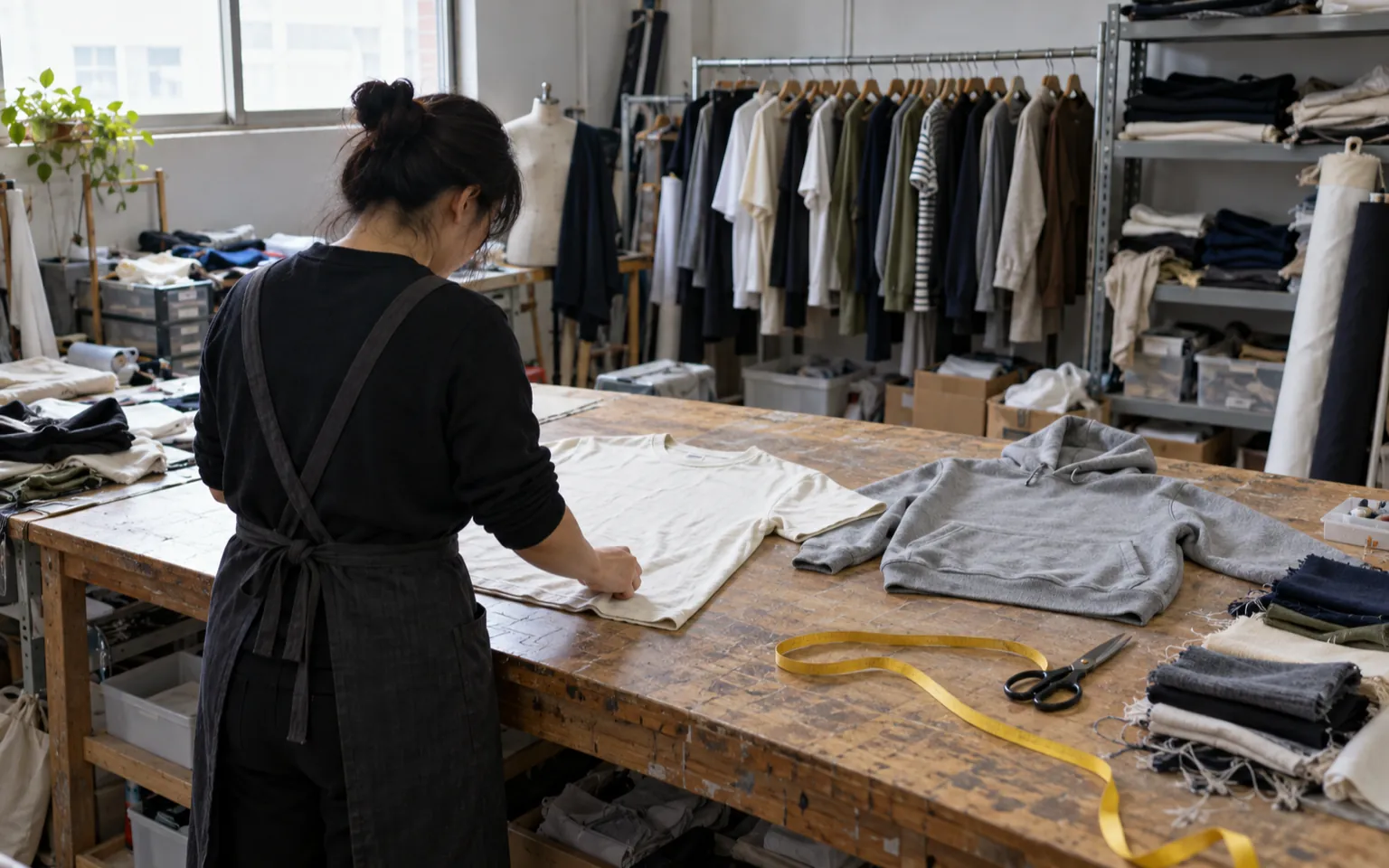
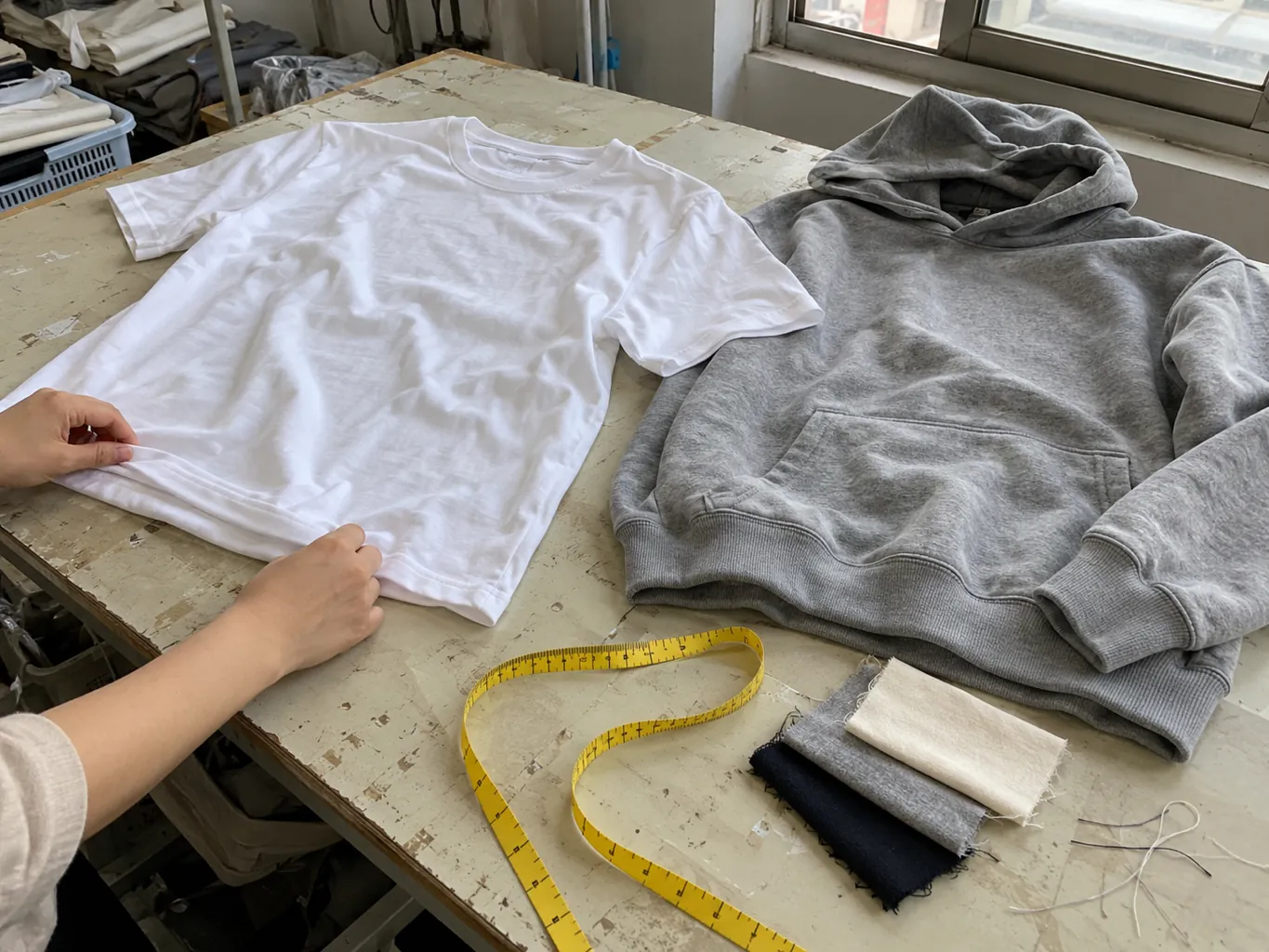
We run OEM production out of Guangzhou for overseas brands — mostly the US, Australia, and the EU — and we've been at it for more than a decade. The rest of this is what we tell first-time buyers before they order: the steps, the costs, and the three mistakes that have actually killed first runs for our clients.
How Many Steps (and How Much Money) Does It Take? The Full Map First
Four steps — position, find a factory, sample, produce — with core costs of $8–12 per unit plus $50–150 per sample.
Here is the whole journey in one table:
| Step | What you do | Typical timeline |
|---|---|---|
| 1. Position | Pick your product, audience, and price point | Your call |
| 2. Find a factory | Shortlist, verify, agree on MOQ and terms | Days to a few weeks |
| 3. Sampling | Approve fit, fabric, color, logo | 7–14 days per round |
| 4. First production run | Bulk sewing, inspection, shipping | About 30 days |
Two steps carry most of the money: step 3 (sampling at $50–150 per piece) and step 4 (goods at roughly $800–3,600 for 100–300 units at $8–12 each).
Two failures account for most first-run disasters, and both happen because of something a buyer skipped between these steps: pushing the factory into bulk production before the sample was properly confirmed, and never agreeing on an inspection standard before the goods were finished. Both show up in the three cases below, all from our own production floor.
One more budget item belongs on the map before you start: shipping. Air and express rates out of China move with the lane, the cargo and the season, so get a current quote for your actual carton weight and destination rather than planning on a published average. For a first run this small, expect the quote to be built on weight — not a flat per-order fee.
Step 1: What Should I Sell, to Whom, and at What Price?
Start with T-shirts or hoodies — they carry the lowest sampling costs, the most flexible MOQs, and the fastest path to a sellable product.
Your first product decision locks in everything downstream: which factories can serve you, what your MOQ looks like, and what your margin can be. Basic knitwear — T-shirts and hoodies — is where most new brands should start. The construction is simple. Every serious factory knows these fabrics. Sampling sits at the low end of the $50–150 range.
Complex styles sit at the other end. Dresses and suits involve more pattern work, more construction steps, and more fittings, so sampling runs more expensive and the approval cycle stretches. That doesn't mean you can't launch with a blazer — it means you'll burn more time and money getting it right, and a first-time buyer has little room for either.
Once you've picked a category, set your price by working backwards from retail. A common rule of thumb in apparel retail is to price at 2.5–4 times your production cost. At an $8–12 per-unit cost, that math supports a retail price of roughly $20–45. If your brand story demands a $100 retail tag, you either need a product whose construction justifies a higher factory cost, or you need to accept that your current factory quote won't support your brand position.
Your target market sets your compliance obligations, and this is a hard gate, not a detail. Industry guidance is consistent on the basics: in the US, the FTC enforces federal labeling rules requiring most textile and wool products to carry a label stating fiber content, and US clothing and textiles compliance guides also cover chemical restrictions, lab testing, and certification requirements. Across the USA, Canada, and Mexico, textile labeling rules focus largely on fiber composition, size, and country of origin. For Australia and the EU, the same categories — fiber content, country of origin, and care labeling — are the ones to verify for your destination before you print a single label.
Step 2: How Much Budget Do You Actually Need for a First Run?
Anchor your budget on goods ($800–3,600 for 100–300 units) and samples ($50–150 each); trims, shipping, and inspection sit on top.
Work the numbers at the two order sizes most first-time buyers consider:
| Item | 100 units | 300 units | Notes |
|---|---|---|---|
| Goods ($8–12/unit) | $800–1,200 | $2,400–3,600 | Your core cost |
| Samples (1–2 rounds) | $50–150 each | $50–150 each | Tees/hoodies at the low end, suits/shirts higher |
| Factory visit (optional) | $100–200/person/day | same | Simple visit; do it before committing |
| Formal audit (optional) | — | — | $3,000–5,000; only before a large commitment |
| Final inspection | $100–200/person/day | same | For small orders, a final inspection is enough |
| Trims (tags, labels, bags) | Ask for an itemized quote | same | Hang tags, care labels, packaging |
| Shipping to US/AU/EU | Weight-based; get a current quote | same | Quote on your actual carton weight and destination |
The items most first-time buyers forget are the trims: hang tags, care labels, and packaging. They look minor next to the garment cost, and they routinely decide whether a shipment ships on time.
The classic version: a buyer confirms the order, production finishes on schedule, and only then asks about custom zipper bags with a printed logo. Custom zipper bags take 3–4 weeks to produce — longer than the whole production run. The order ships in plain transparent bags with no branding, or it waits a month. We watched exactly this happen to one of our clients; the full case is in Step 5.
Step 3: How Do You Find a Reliable Clothing Factory in China — and What MOQ Should You Expect?
Shortlist online, verify by video, pay for an in-person visit at $100–200 per person per day, and save the $3,000–5,000 formal audit for a major commitment.
Start by matching the factory to your product. Capacity numbers tell you quickly whether you're in the right place. A factory running T-shirt and hoodie lines at real scale produces 30,000–50,000 units a month; dresses and suits, which take more labor per piece, typically run 10,000–20,000 units a month. In our experience, small orders usually land between 100 and 500 units. E-commerce brands that market well come back with reorders in the thousands — sometimes tens of thousands. Pick a factory that fits the size you are now, not the size you hope to be.
On MOQ, a realistic read: 100 units per style is a common industry floor, and factories can be flexible when a project genuinely requires it — ours is 100, and we adjust when the situation calls for it. Don't be scared off by a quoted 500, and don't blindly trust a factory that advertises "no MOQ." Both extremes hide something: the rigid number usually belongs to a factory organized only for large runs, and "no MOQ" often means you're talking to a trading company subcontracting to whoever has spare capacity.
Then verify in escalating steps, cheapest first:
- Shortlist online — Alibaba, Google, industry directories — and eliminate anyone who can't show real production photos.
- Ask for a live video factory tour. A real factory walks you through cutting, sewing, and finishing areas without hesitating.
- Pay for a simple visit: $100–200 per person per day. Someone walks the floor and checks what the video showed.
- Before a large or long-term commitment, commission a formal audit: $3,000–5,000. This is the step that matters once real money is on the table.
The most common mistake we see at this stage: buyers comparing quotes line by line while never asking to see a factory audit report. A quote is a claim. An audit report is evidence. A buyer who shops on price alone is choosing between stories, not factories.
Step 4: How Does Sampling Work — Cost, Timeline, and What to Confirm?
Sampling costs $50–150 per piece, takes 7–14 days, and only counts when every detail is confirmed in writing.
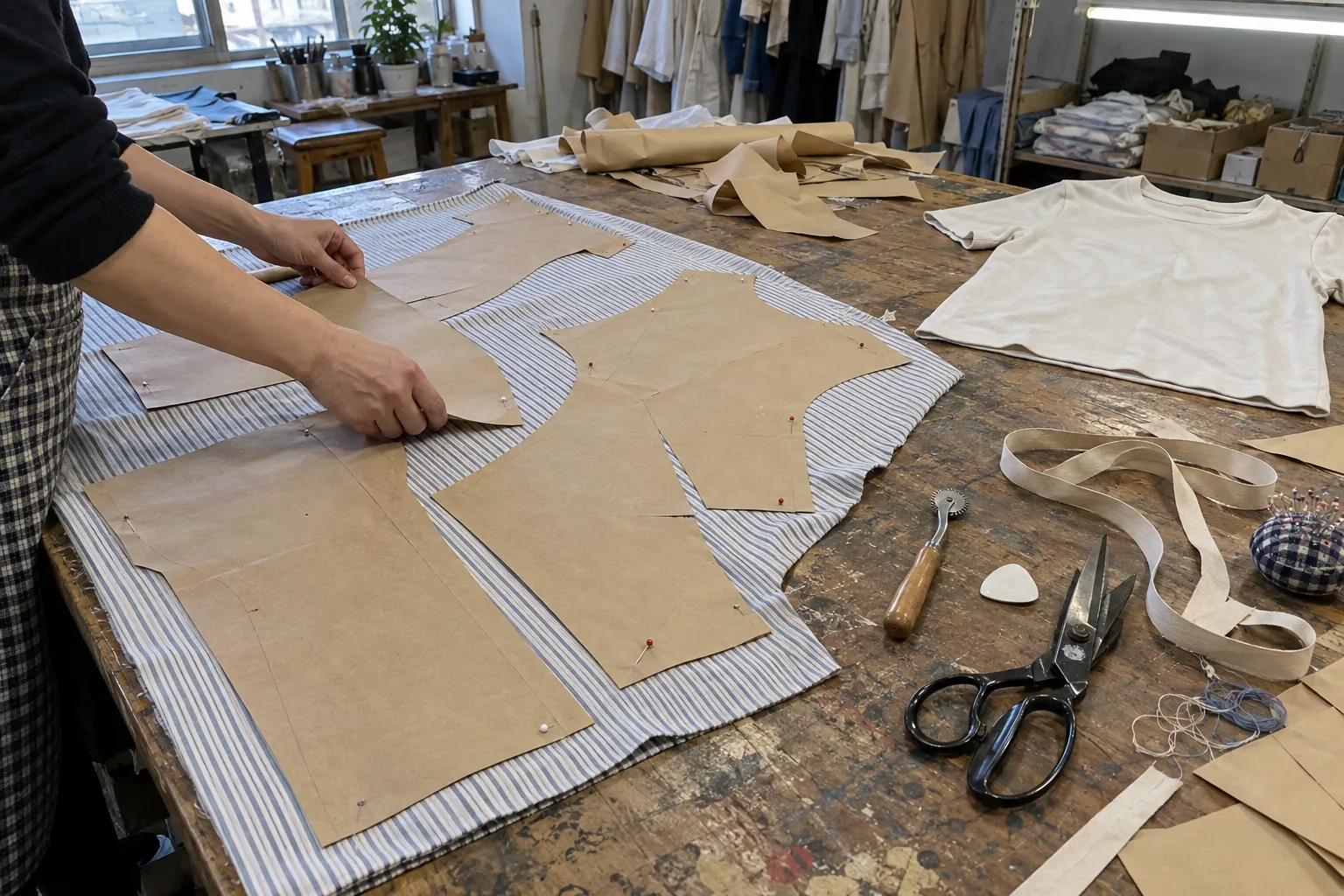
Two numbers to plan around: our sampling cycle runs 7–14 days per round, and sample fees run $50–150 per piece depending on the style — T-shirts and hoodies land at the cheap end, suits and dress shirts at the expensive end. Budget for at least one revision round; almost every first-time buyer needs one.
When the sample arrives, confirm five things against it, one by one:
- Fit and pattern — measurements on the size chart match the sample, not just the tech pack.
- Fabric — weight, hand feel, and composition match what you approved.
- Color — check against a physical reference or a Pantone code under daylight.
- Construction — stitching, seams, and finishing details.
- Logo version — the logo on the sample is the final, current version of your artwork. This is the single most common sampling failure we see.
That last point deserves its own warning, because it has burned real clients: the logo printed on the bulk goods was never the wrong logo from the factory's side — it was an outdated version the buyer had stopped using. The factory printed exactly what it was given. Locking the logo version in writing, with the artwork file attached to the order record, takes five minutes and has saved more first runs than any other habit.
And "confirmed" means documented. A reply of "looks good" in a chat message is not a confirmation — two months later, nobody can prove which sample state that message referred to. Put the approval in the order paperwork, dated, with the sample photos attached.
Step 5: How Do You Keep Your First Production Run From Going Wrong?
Every first-run failure we've handled traces back to one habit: details confirmed too late, or never written down.
With 100–300 units, you have no margin for a do-over — one failure is your entire inventory and cash position. These three are the ones we hand to new buyers, all from real orders we've produced.
Case 1: Pushing into bulk before the sample was confirmed.
A buyer approved the general direction of a sample and pushed the factory to start bulk production quickly. The garments came off the line and the logo was wrong — not a quality defect, but the wrong version of the logo, different from the artwork on the buyer's own website. The goods were wearable and well made, but every unit carried branding that didn't match the brand customers saw online. Fixing it meant reworking the logo application on the entire batch.
Case 2: Never agreeing on an inspection standard.
We produce consumer-grade goods, not luxury. One buyer arrived at final inspection with a standard far beyond normal consumer expectations and flagged issues that an ordinary customer would never notice as defects. Under the usual consumer-goods standard — AQL 2.5 for major defects and 4.0 for minor ones — that batch passed. Under the standard the buyer applied in the room, it didn't, and the shipment stalled. The entire dispute could have been avoided with one written agreement before production started.
Case 3: Forgetting packaging until the goods were done.
Our client Ann Lin confirmed her order without confirming packaging. When the order was ready to ship, she asked for custom zipper bags with her logo — and custom zipper bags take 3–4 weeks to produce. There wasn't time. The order shipped in plain transparent bags with no logo at all. The garments were fine; the unboxing experience she had planned for her customers was gone.
The fix for all three fits in two sentences. Confirm every piece of trim artwork — bags, tags, labels — at the moment you confirm the order, not when production finishes. And agree your inspection standard (AQL 2.5/4.0 for consumer goods) in writing before the first unit is cut.
Step 6: How Do You Protect Your Money and Your Goods: Deposits, Inspection, and Balance Payments?
For new clients the industry standard is 30% deposit, inspection before shipment, and the balance paid before the goods leave the factory.
Cross-border payment terms intimidate first-time buyers more than any other part of the process, and in practice the structure is simple. The standard sequence for a new client: a 30% deposit to start production, the right to inspect the goods before shipment, and the balance paid before the goods ship. You are never paying the full amount before you've seen evidence the order exists and matches your sample.
Once a relationship is established, terms loosen. For repeat clients, we offer 30–60 day balance terms based on the buyer's credit check through Sinosure, China's export credit insurance system — the same mechanism factories across Guangzhou use to extend credit without gambling on a stranger.
On inspection itself: third-party inspection runs $100–200 per person per day, and for a 100–300 unit order, a final inspection is enough. Skip pre-production and in-line inspections at this scale — they make sense when a defect costs you tens of thousands of units, not three hundred.
Step 7: The 15 Questions You Should Ask a Clothing Manufacturer Before Ordering
Before ordering, ask about capacity and production lead times, MOQ, sampling costs and timelines, approval processes, trims, inspection standards, payment terms, and what the unit price includes.
Every point above, turned into a question you can send to any factory. Do it before you wire a dollar. A good answer always contains a number, a timeframe, or a named process. Ask the factory to confirm the unit price and bulk production lead time in writing.
Capacity
- What is your monthly capacity for this product category? A real answer sounds like: 30,000–50,000 units a month for T-shirts and hoodies, 10,000–20,000 for dresses and suits. Ask for monthly capacity figures for your product category.
- How long does bulk production take for 100–300 units? Look for a specific figure — around 30 days — stated confidently and in writing.
- If my reorder grows from 300 to 5,000 units, can you scale with it? A factory set up for growing e-commerce brands will say yes without hedging.
MOQ and sampling
- What is your MOQ per style, and can it flex? A specific number with honest flexibility behind it (ours is 100) is credible. Both "no MOQ" and an unexplained hard 500 deserve follow-up questions.
- What do samples cost? $50–150 per piece depending on style complexity is a normal range. Alarm bells ring when sampling is free but unit prices are vague.
- How long does sampling take? 7–14 days is a realistic cycle from a factory doing its own sampling.
Process
- What exactly should I confirm on my sample? A good factory hands you the list: fit, fabric, color, construction, and the final logo version.
- How do you guarantee the bulk run uses my final logo version? Look for a written, version-controlled confirmation step before production — not "we check with the workshop."
- Who handles trims, and when must the artwork be final? Everything should be locked at order confirmation, and the factory should proactively warn you that custom zipper bags take 3–4 weeks.
- What inspection standard do you work to? For consumer-grade goods, the answer should be AQL 2.5 for major defects and 4.0 for minor ones — agreed in writing before production.
- How are approvals and changes documented? In the order record or PI, dated. Not in chat messages.
Money
- What are your payment terms for a new client? The standard answer: 30% deposit, balance before shipment.
- Can I inspect the goods before paying the balance? Yes is the only acceptable answer; inspection before shipment is standard practice.
- What terms open up for repeat orders? Look for structured answers like 30–60 day balance terms backed by a Sinosure credit check — not vague promises.
- What exactly does your unit price include? A good factory itemizes — fabric, cutting, sewing, standard packaging — instead of quoting one unexplained lump number.
Send all 15 in your first email. The factories that answer fully and quickly are your shortlist; the ones that reply with a price list and a smile are telling you something.
Ready to Place Your First Order?
If you're planning a first production run, our MOQ of 100 (flexible where a project needs it), 7–14 day sampling, and $8–12 unit pricing fit it directly.
That's the whole map — positioning, budget, factory screening, sampling, production, payment terms, and a 15-point checklist to put any factory through. The next step is a conversation about your specific product.
Send four things in your first message and we skip the back-and-forth: your product category, your quantity, your target price, and reference images of what you're aiming for. We respond within one business day, and you can also reach us through the WhatsApp button on this page. Bring your questions from the list above — we answer them with numbers.
Frequently Asked Questions
What is a realistic first order size for a new clothing brand, and what does it cost?
Most first-time buyers start with 100–300 units. At $8–12 per piece, that means roughly $800–3,600 in goods, plus sampling at $50–150 per piece, with trims, shipping, and inspection on top.
How long does sampling take, and how many rounds should I plan for?
One sampling round takes 7–14 days. Plan for at least one revision round, because almost every first-time buyer needs one.
How long does bulk production take after I confirm the order, and what has to be locked first?
Bulk production takes about 30 days for 100–300 units. Before it starts, confirm every piece of trim artwork — bags, tags, and labels — at order confirmation, and agree your inspection standard in writing, since custom zipper bags alone take 3–4 weeks to produce.
What payment terms should a new clothing brand expect from a factory?
For new clients the standard is a 30% deposit to start production, the right to inspect the goods before shipment, and the balance paid before the goods ship. Repeat clients can open up 30–60 day balance terms after a credit check through Sinosure.
What inspection standard should I agree on for consumer-grade clothing?
Agree on AQL 2.5 for major defects and 4.0 for minor ones, in writing before the first unit is cut. For a 100–300 unit order, a final inspection at $100–200 per person per day is enough — you can skip pre-production and in-line inspections at this scale.