How to Read a Custom Apparel Quote: The Six Cost Blocks
Every custom apparel quote is built from six items: fabric, trims, labor, printing/embroidery, packaging, and factory margin.
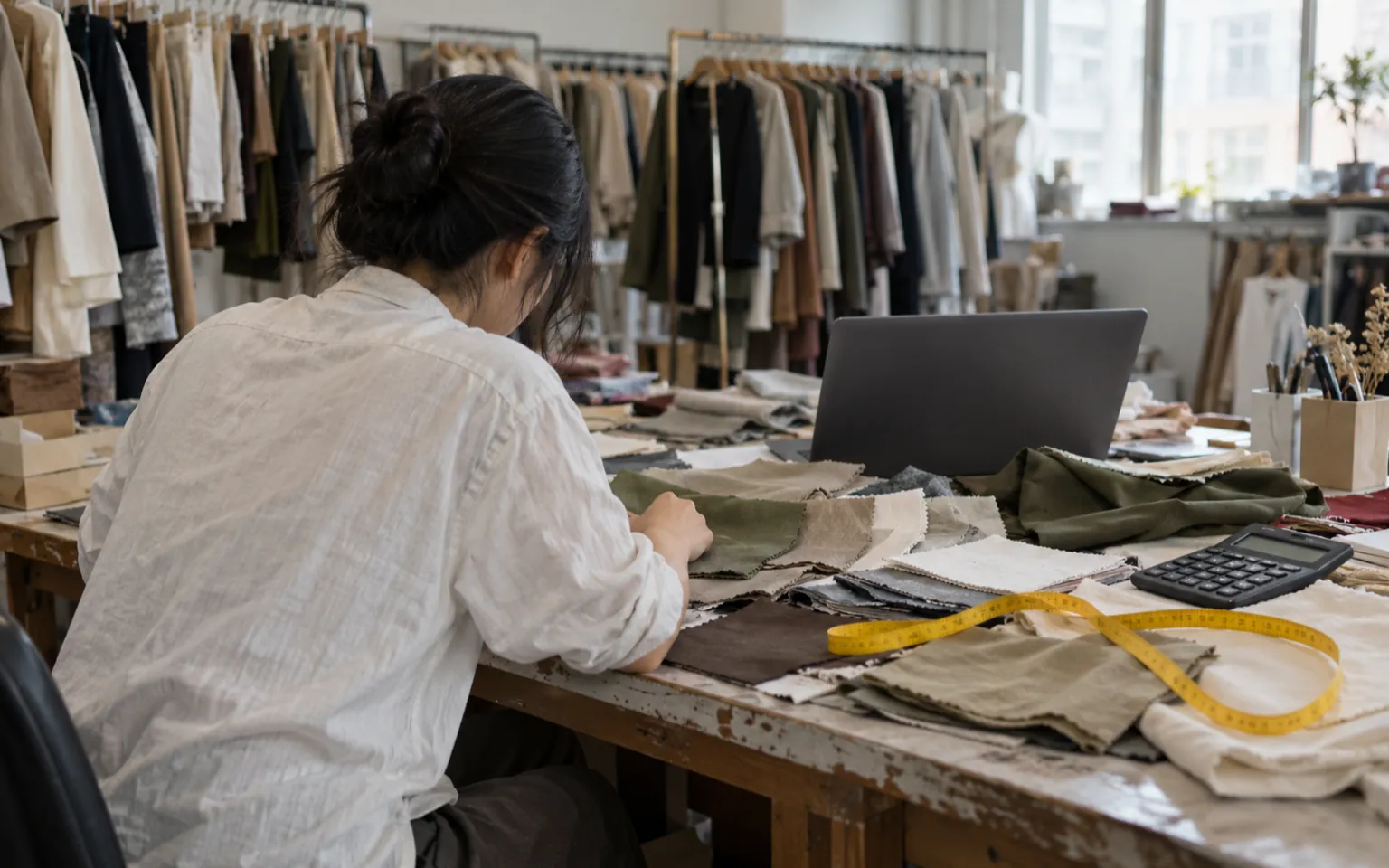
Fabric is almost always the largest variable. The same pattern in different fabrics can easily double the unit price — a basic cotton knit and a heavy blended fleece are barely the same product in cost terms, even when the cut is identical.
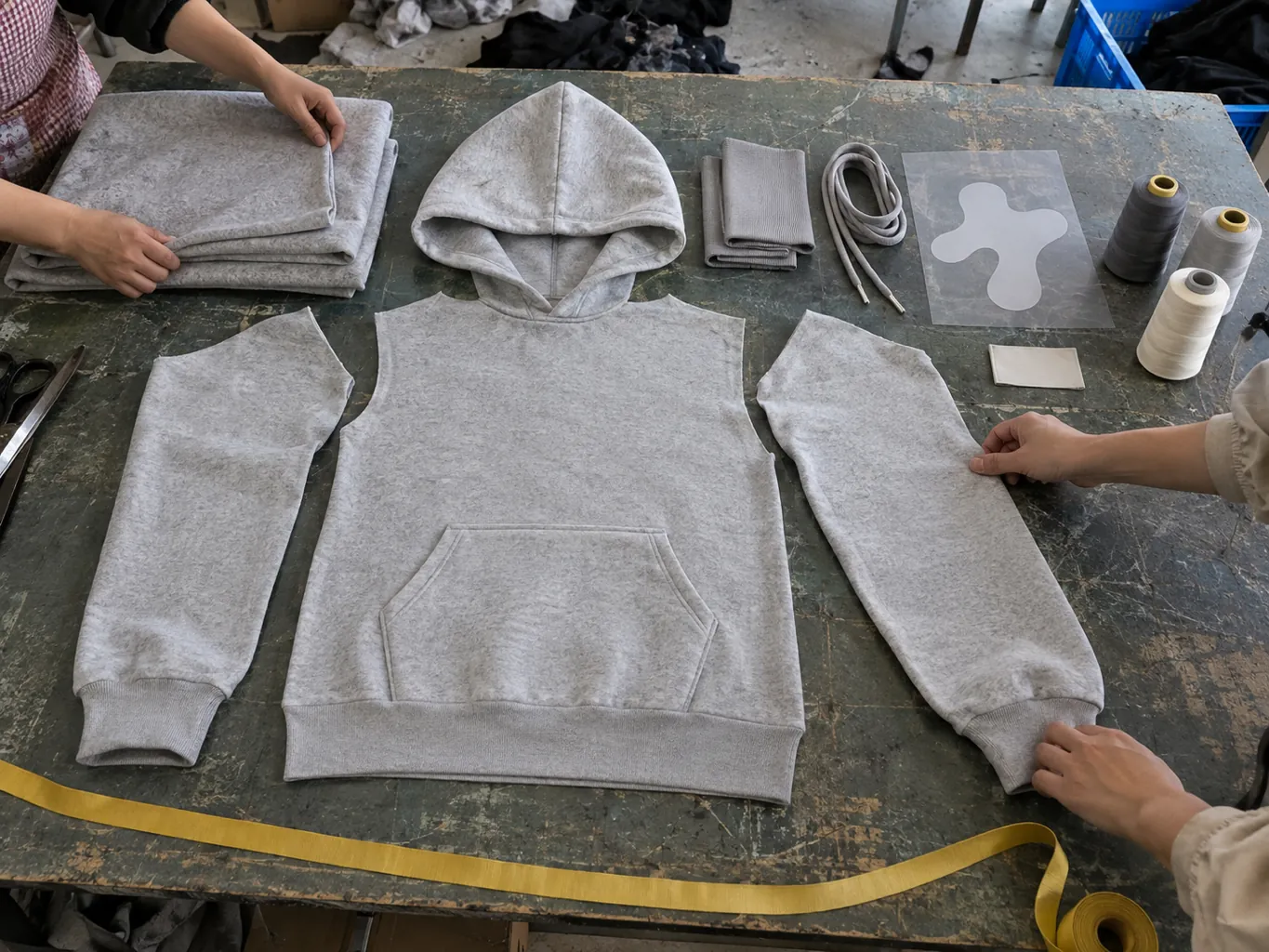
Trims are the small parts: buttons, zippers, drawstrings, woven labels, care labels, thread. Individually cheap. Together, a branded zipper, a custom woven label and a printed hang tag add up — and every trim has to be sourced before production starts. That is why last-minute packaging requests blow up schedules.
Labor follows construction complexity. In the partner factories we coordinate, a line making T-shirts and hoodies turns out 30,000–50,000 pieces a month; dresses and suits, with their darts, linings, and pressing steps, run 10,000–20,000. Same workers, same hours — when output per line halves, the labor cost inside each piece roughly doubles. This is most of the reason a dress quote looks so different from a T-shirt quote.
Printing, embroidery, and packaging each carry their own charges. Comparing these costs across quotes is where buyers often run into trouble.
Every quote also contains the factory's margin. A margin isn't a red flag — it's how factories stay alive to deliver your reorder. The red flag is a factory that won't show you the six blocks at all. Ask for an itemized quote: fabric, trims, labor, print/embroidery, and packaging listed separately. A single total number can't be compared against another single total number. Two itemized quotes can be compared line by line in five minutes.
How Fabric, GSM, and Print or Embroidery Change the Unit Price
GSM — fabric weight — is the biggest single driver of material cost, and printing or embroidery add their own charges on top.
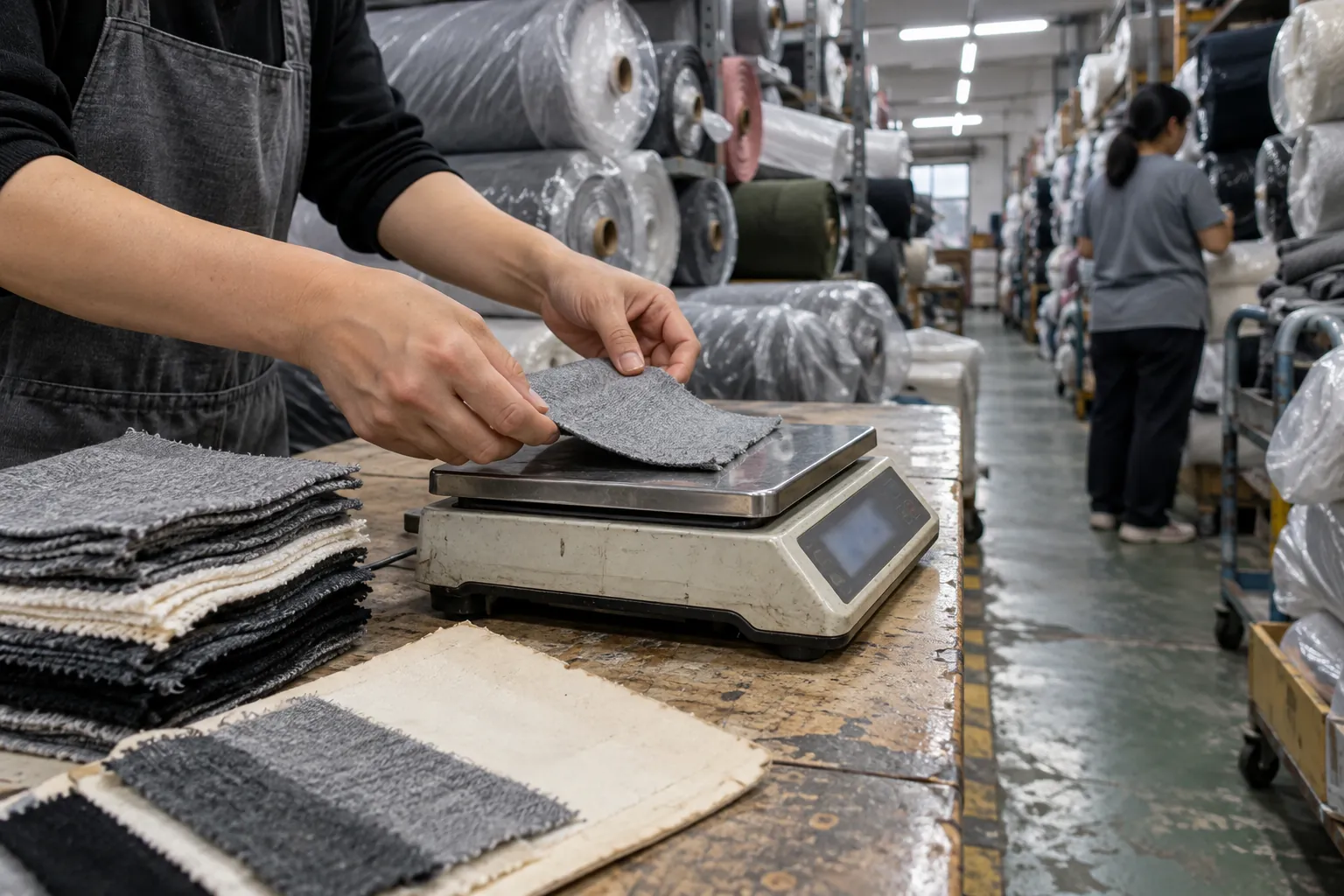
GSM means grams per square meter. A higher-GSM knit packs in more yarn per square meter, so material cost climbs with weight. GSM also drives how the garment feels and how long it lasts — which is why two quotes for "a cotton T-shirt" are meaningless until the GSM is fixed. Get fabric composition (100% cotton, a cotton-poly blend, viscose) and GSM stated in writing, from every factory, every time. Cotton T-shirts typically use fabric in the 160–280 GSM range, while sweatshirts typically use fabric in the 200–350 GSM range.
Printing is priced by technique, number of colors, and number of print positions. Screen printing is usually quoted per color per position — each additional color means another screen, another pass, another curing step. Heat transfer and direct-to-garment price differently and suit different designs.
Embroidery is priced by stitch count and embroidered area. A small chest logo and a full-back embroidered design are different products in cost terms, and special effects like 3D foam or thick thread cost more on top.
Anything beyond standard cut-and-sew — garment dyeing, enzyme washes, distressing, bonded seams — is a separate process with its own price tag. Never assume it's inside the unit price. Ask.
So send one identical tech pack to three factories and ask each for a fabric + process itemization. You can immediately see which fabric or process charges differ. If a factory refuses to itemize, rule it out before comparing prices or ordering samples.
What Is the MOQ, and How Much Does the Unit Price Drop as Quantity Rises?
Our MOQ is 100 pieces per style — and if you genuinely can't start there, talk to us: a 100–200 piece trial order is a normal way to begin.
Based on the orders we've handled over the years, most first orders land between 100 and 500 pieces. Brands that find traction — e-commerce sellers whose marketing works — come back with reorders in the thousands, sometimes tens of thousands.
The reason quantity moves price is fixed costs. Every order carries one-time work that doesn't scale with volume: pattern making, machine setup, buying fabric in small lots (mills charge more per meter at low volumes), sourcing trims, and QC preparation. Spread over 100 pieces, that fixed work weighs heavily per piece. Spread over 5,000 pieces, it becomes almost invisible.
Take an order with $800 of one-time work — pattern, setup, small-lot fabric surcharge. At 100 pieces, that's $8 per piece. At 1,000 pieces, it's $0.80. At 5,000, it's $0.16. The fabric and labor inside each garment don't change; the fixed-cost share does. (These figures illustrate the mechanism — they are not a quote.)
When you want a lower unit price, add quantity before you squeeze the labor rate. Guangzhou labor costs leave little room for cuts. Higher quantities give you more room to lower the unit price. Asking a factory to "just make it cheaper" forces them to guess where to cut, and you won't like their guess.
How Much Does Sampling Cost, and How Long Does It Take?
Sample fees typically run $50–150 per piece, and sampling takes 7–14 days after specs are confirmed.
The fee depends on the garment. T-shirts and hoodies sit at the low end; shirts and suits at the high end, because pattern work and sewing hours multiply with construction.
The fee covers real work: a pattern maker drafts from your tech pack, fabric is bought at sample-lot prices (suppliers charge more per meter for small quantities), and one sewer spends hours on a single garment instead of dozens. Factories don't make margin on samples — the fee exists so sample requests stay serious.
Before you pay, agree on how many revision rounds the fee covers. "One round of reasonable changes" is a common structure, but common is not universal — get it confirmed in writing so your second fitting doesn't become a second invoice.
Count 7–14 days for sample production, plus courier time to your door, and build both into your launch calendar alongside bulk lead time. Check the sample against your size chart. Check stitch density, print placement, label position, fabric hand feel. Then approve it or annotate it in writing. Don't sit on it — the bulk clock can't start without a sign-off.
The rule is: bulk production starts only after the final sample is confirmed — the exact logo file, the exact fabric, the exact labels. The first case in the lessons section below shows what skipping this costs.
The Costs That Never Appear on the Quote
Beyond the unit price: inspection runs $100–200 per person per day, a formal audit $3,000–5,000, custom packaging needs 3–4 weeks, and freight depends on your Incoterms.
Third-party QC in China commonly charges $100–200 per person per day. You have three possible inspection points — pre-production, during production, and final — but for small orders we advise a final (pre-shipment) inspection only. Below a few hundred pieces, a pre-production inspection rarely pays for itself.
If your compliance program requires a formal social-compliance audit, such as BSCI, budget $3,000–5,000. A simple factory visit — you or an agent walking the floor for a day — typically costs $100–200 per person per day.
Custom packaging is the classic budget leak. A custom zipper bag takes about 3–4 weeks to produce, which is longer than many buyers' entire remaining schedule when they remember it. Packaging, hang tags, and labels must be confirmed with final artwork at the same moment the order is confirmed. That is the mistake that cost Ann Lin her branded packaging for a whole first order.
A $6.80 FOB quote and a $9.50 DDP quote cover different costs, so you can't compare the totals directly. Under FOB, the factory's responsibility ends at the port of departure; ocean or air freight, insurance, import duty, and destination charges are yours. Under DDP, the factory prices the goods all the way to your door, risk included. For context: about 80% of our export volume goes to the US, with 10% to Australia and 10% across EU countries, so freight and duty questions are daily work for us.
Is a Quote Fair? Where to Negotiate and Where to Walk Away
A quote below the actual cost of its own fabric is bait, and the right negotiation order is fabric first, processes second, quantity third, labor rate last.
A quote that can't cover its stated fabric and labor has to recover money somewhere. The standard moves: substitute cheaper fabric in bulk, or quietly drop the GSM below what was quoted. Both are invisible in a photo and obvious at the inspection table or in the wash. Your defense is to pin fabric composition and GSM in writing and check bulk goods against the approved sample.
When you negotiate, work the list in this order:
- Fabric — swap to a cheaper composition or a lower GSM with the same look. Biggest lever, transparent math.
- Processes — one fewer print color, a standard label instead of a woven one.
- Quantity — raising the order size spreads fixed costs.
- Labor rate — last and least. A factory that agrees to a squeezed labor rate too easily is making it up somewhere else.
A factory that refuses an itemized quote is telling you something. So is one that won't state GSM or composition, or one that demands full payment before you can inspect. Each refusal leaves you with less information to judge the risk of your first order.
Cheapest quote is not the same as cheapest order. One failed bulk run — a wrong logo version, a failed inspection, goods you can't sell — erases the savings and burns a month of your calendar.
For reference when judging terms: normal terms look like ours: a 30% deposit to start production, your right to inspect before shipment, and the balance paid in full before the goods ship; once you are a repeat customer, balance terms of 30–60 days can be offered based on credit-insurance checks.
Payment Terms: Deposits, Balance, and Credit
For a first order, normal terms look like ours: 30% deposit to start, your right to inspect before shipment, and the balance due before the goods ship — in that order, written into the contract.
For new clients, we work like this: a 30% deposit starts production. Before shipment, you or your third-party inspector can check the goods. The balance is paid before the goods leave the factory.
The deposit exists because the factory fronts real money — fabric and trims are bought in cash before the first seam is sewn. A deposit far below that level means the factory is financing your business out of its own pocket. Either the factory isn't actually covering those costs, or financing the order that way will cause problems.
Returning clients with an order history can apply for 30–60 days of credit on the balance, subject to a Sinosure check. Sinosure — China Export & Credit Insurance Corporation — insures exporters against buyer default. That is what makes credit terms possible for a supplier that would never otherwise finance a foreign buyer's inventory.
Whatever terms you agree on, keep the sequence: produce, inspect, pay the balance, ship. A factory demanding the full balance before you can inspect is moving all the risk onto you; a buyer who pays everything before seeing goods has no leverage left. And agree currency and transfer fees in writing before the first invoice, so a $30 bank charge doesn't become a three-day argument.
Three Real Lessons: Details Not Confirmed in Writing, Bills Paid in Cash
The three lessons: approve the sample with the final logo artwork before bulk production, agree inspection standards and AQL levels in writing before the deposit, and confirm all packaging and trims with final artwork when you confirm the order.
Lesson one: the logo version.
Bulk was pushed into production before the sample was confirmed against the final design file. The bulk logo matched an older version — not the brand's current logo on the client's website. It wasn't a quality defect, and the goods were wearable. But consumers notice, and for a brand, look and feel is the product. The fix: the sample you approve must carry the final logo artwork, and bulk starts only after that approval.
Lesson two: the inspection standard.
A buyer never communicated an inspection standard before production. At final inspection, they applied a far stricter bar than standard consumer-goods practice — details a normal consumer would never notice were flagged, and the shipment stalled. Under the usual consumer-goods levels (AQL 2.5 for major defects, 4.0 for minor), the goods would have passed. The fix: agree the inspection standard and AQL levels in writing before the deposit. If you have unusual requirements, state them as requirements — not as surprises.
Lesson three: the packaging.
Our client Ann Lin confirmed her order without confirming packaging. When the order was ready to ship, she asked for custom zipper bags — and zipper bags take about 3–4 weeks to produce. There was no time, so the first order went out in plain transparent bags with no logo. The fix: confirm every piece of packaging and every trim — bags, hang tags, labels — with final artwork at the same moment the order is confirmed, not when the order is ready.
None of these were quality failures. The missing step was confirming the details, which costs nothing.
Our Approach: Publishing MOQ and Price Ranges Openly
We put our numbers on the table: MOQ 100 pieces per style, unit price ranges broken down by category and quantity tier, and certifications disclosed exactly as they stand.
On MOQ: 100 pieces per style. If your launch genuinely can't support that, talk to us. We're flexible when the situation warrants it — a 100–200 piece trial order is something we do regularly.
On prices, we publish ranges rather than a single number, because fabric, GSM, and process choices all affect the cost. A single "unit price" without those inputs would be marketing, not pricing. Send your style, fabric and quantity and we will price those inputs for you.
On certification, we disclose it plainly: our partner factories hold BSCI certification — and the certificate sits in each factory's name, not Canton Fashion's. We state this because your compliance file needs the actual certificate holder, and because a trading company claiming "we are BSCI certified" without paperwork is a warning sign, not a credential.
Why we can open the books: Canton Fashion was founded in Guangzhou in 2015. Instead of one owned plant, we coordinate a network of partner factories, and we place each order with the factory whose machines and capacity fit it. With this setup, we can explain the price line by line. We prefer to share that breakdown.
Get Your Itemized Quote Within One Business Day
Send your design and target quantity. An itemized quote comes back within one business day.
Start through the contact form or the WhatsApp button on this page — full contact details are on our website, and our usual response time is one business day.
The more complete your message, the sharper the quote:
- Your design file, tech pack, or a photo of a reference garment
- Target quantity per style and color
- Target fabric — or the garment's end use, and we'll suggest options
- Your target price, if you have one
What you get back is a line-by-line quote — fabric, trims, labor, printing or embroidery, packaging — with the assumptions stated, so you can compare it directly against any other factory's quote. If our number is higher, the itemization shows exactly where and why.
Frequently Asked Questions
How can I make sure suppliers are quoting the same garment specifications?
Send the same tech pack to each factory and get fabric composition and GSM confirmed in writing. Ask for fabric, trims, labor, printing or embroidery, and packaging to be listed separately so you can compare the charges.
Are the quantity-based cost examples actual garment prices?
No—the examples illustrate how one-time costs are spread across an order; they are not garment quotes. The lower amount per piece represents a smaller share of fixed costs, not the full cost of making each garment.
Will my sample arrive within the stated 7–14 days?
The 7–14 days covers sample production after specifications are confirmed; courier time is additional. Bulk production starts only after you approve the final sample with the exact logo artwork, fabric, and labels.
When should I finalize branded bags, hang tags, and labels?
Confirm bags, hang tags, and labels with final artwork when you confirm the order. Custom zipper bags take about 3–4 weeks to produce, so packaging needs to be included in your schedule from the start.
Can I inspect my first order before paying the balance?
Yes—Canton Fashion allows you or your third-party inspector to inspect the goods before you pay the balance, which is due before shipment. A 30% deposit starts production, and inspection standards and AQL levels should be agreed in writing before the deposit is paid.